Payge Rivord – EngEd 275-001
Principals 5-9
Principal 5: Effective Teachers Address Standards
The Common Core Standards Initiative has identified the knowledge students are expected to learn at each grade level (K-12). These standards are to be followed and students are expected to meet these standards. The standards are separated into five strands: writing, speaking and listening, language, and media and technology. However, they state what the student needs to know, it does not state how. This gives teachers the freedom and creativity to execute these standards however they see fit.
Principal 6: Effective Teachers Scaffold Students’ Reading and Writing
Teachers scaffold students’ reading and writing as they demonstrate, model, guide, and teach, and thy vary the amount of support they provide according to the instructional purpose and students’ needs. Teachers use five levels of support, moving from more to less as students assume responsibility. These five levels are: modeled, shared, interactive, guided, and independent.

Vocabulary for Principal 6:
- Scaffolding: Teachers provide varying levels of support so that all students can be successful. They use a combination of the five levels of scaffolding.
- Shared Reading: The teacher will chose a book and read it aloud to the class. The teacher does most of the reading aloud, but children join in to read familiar an predictable words are phrases. These phrases usually rhyme or are repetitive.
- Choral Reading: Students take turns reading lines of a poem or story. The students support one another by actively participating and sharing the work.
- Readers Theatre: Students assume roles from a play and read their lines from a script. These are usually introduced, practiced, and then preformed.
- Interactive Writing: Students and the teacher create a text and write a message. The text is composed by the group, and the teacher assists as the students take turns writing the words of the text.
- Minilessons: As teachers teach lessons about strategies and skills, they provide practice activities ans supervise as students apply what they’re learning.
Principal 7: Effective Teachers Organize for Instruction
No single instructional program best represents the balanced approach to literacy; instead, teachers organize for instruction by creating their own program that fits their students’ needs and their school’s standards and curriculum guidelines. Instructional programs should reflect these three principals: Teachers create a community of learners in their classroom, Teachers incorporate the components of the balanced approach, and Teachers scaffold students’ reading and writing experiences. In this figure, there are the popular instructional programs.

Vocabulary for Principal 7:
- Instructional Programs: Programs and activities teachers use to ensure and help their students reach their standard goals.
- Nurturing English Learners: English learners benefit from participating in the same instructional programs that mainstream students do, and teachers create classroom learning contexts that respect minority students and meet their needs.
Principal 8: Effective Teachers Differentiate Instruction
Effective teachers adjust their instruction because their students vary in their levels of development, academic achievement, and ability. This does not mean the instruction changes, but it may be tweaked for certain students to fit their needs. One-size-fits-all techniques are non-beneficial and teachers respect students by honoring both their similarities and their differences.
Vocabulary for Principal 8:
- Differentiation: Making changes or tweaks to a lesson plan or instructional approach to challenge and benefit all students.
Principal 9: Effective Teachers Link Instruction and Assessment
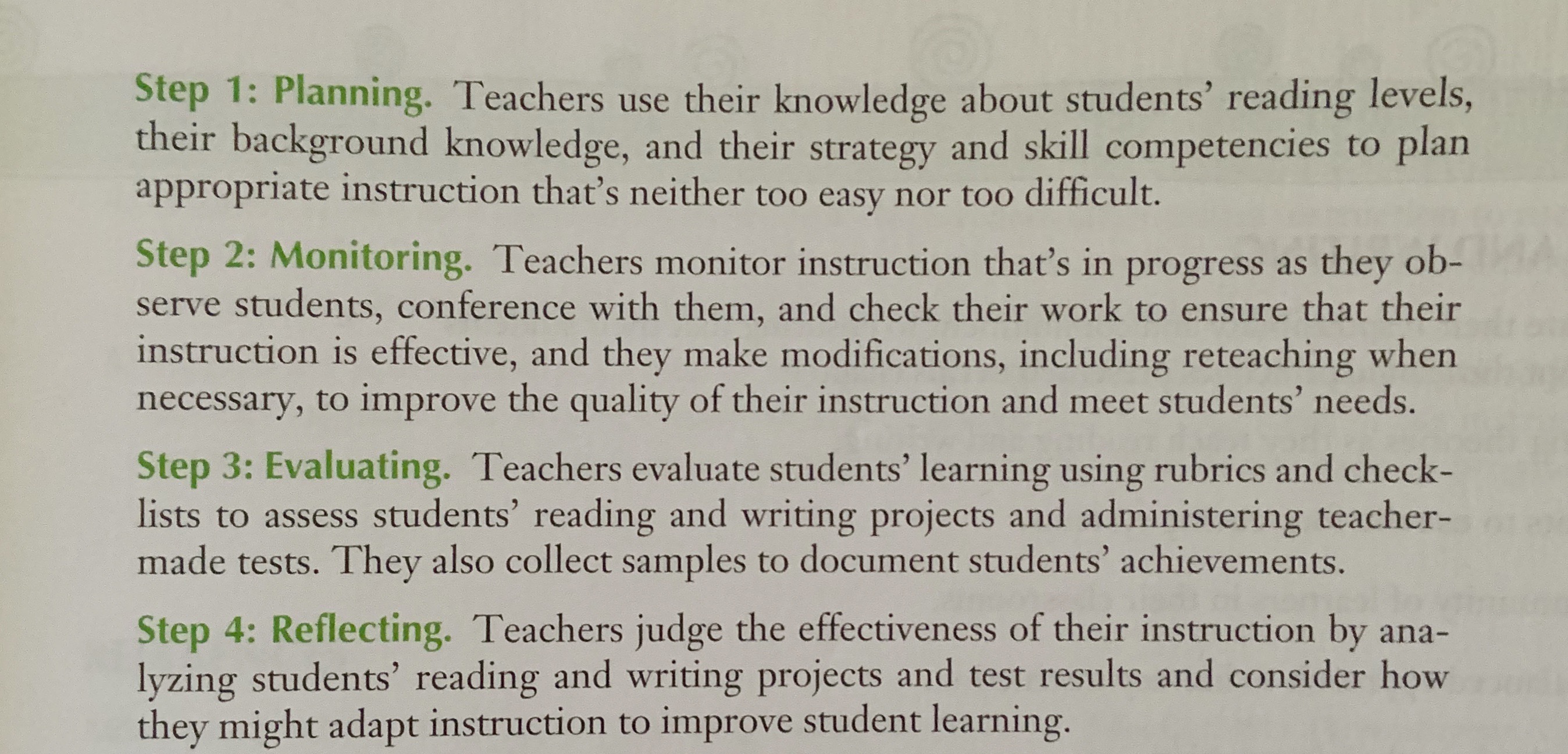
Assessment is seen in test taking, but is also a daily part of classroom life. Teachers collect and analyze data from observations, conferences, and classroom tests, and they use the results to make decisions about students’ academic achievement and plan interventions.
Vocabulary for Principal 9:
- Assessment: An integral and ongoing part of both learning and teachers, and a way to assess the student to see where they are, where they excel, and where they fall behind.
- Running Records: A record of a students oral reading to help identify errors made.
- Linking Instruction with Assessment: Teachers link instruction with assessment using four steps. These steps are listed in the picture below.
- Rubric: A set of guidelines and expectations for a specific project that assess the students work.
How will this look in my classroom?
All of these principals should be provident in the classroom. Rubrics and assessments are implemented everyday, whether they be observations or written evaluations. Differentiation is very important as well. This will be something I will try to execute everyday, with at least one lesson, because it is important to me that my students benefit from practice to the fullest extent possible.

 Payge Rivord