Payge Rivord EngEd 275-001
The Reading Process
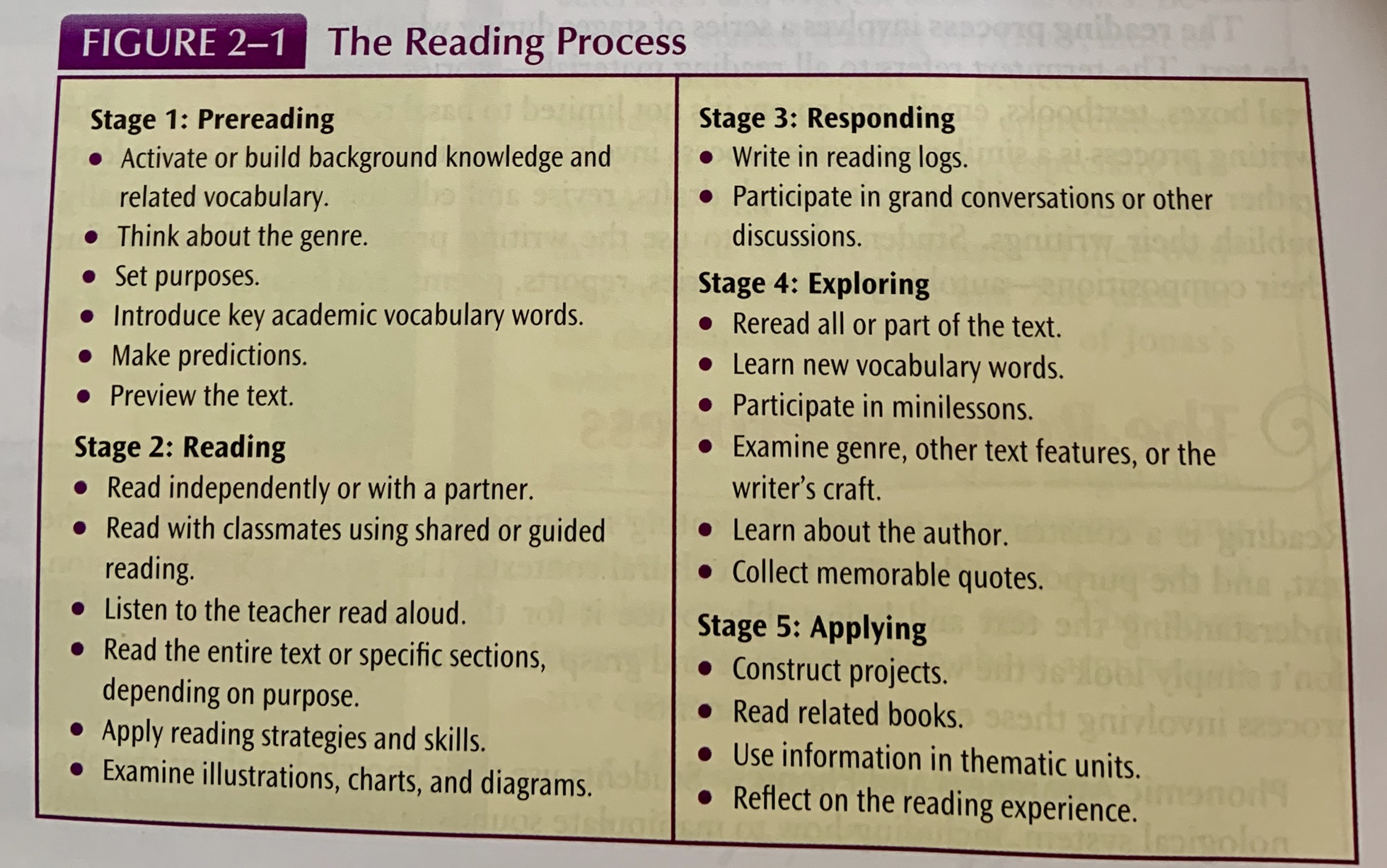
The reading process has five stages. It is always used, no matter what instructional process a teacher chooses. Although, the activities teachers use for each stage may vary, they all teach using the writing process. Figure 2-1 states all five stages and what happens in each stage.
Vocabulary involving the reading process
- Phonemic Awareness: The understanding and ability to identify the smallest unit of sound in a word.
- Phonics: Writing. Anything in written words in considered phonics.
- Word Identification: Students recognize high frequency words automatically and use their knowledge of phonics and word parts to decode unfamiliar words.
- Fluency: The ability to recognize most words automatically, to then be able to read quickly with expression. Fluent readers devote most of their cognitive resources, instead of focusing on identifying the words their reading.
- Vocabulary: Students chose appropriate meaning, recognize figurative uses, and relate them to their background knowledge. Knowing the meaning of words influences comprehension.
- Comprehension: Students use a combination of reader and text factors to understand what they’re reading. TO create meaning they predict, connect, monitor, repair, and use other comprehension strategies.
Students use phonemic awareness and phonics to be able to learn word identification, fluency, vocabulary, comprehension. There are the basis of all reading and writing skills.
Vocabulary Continued
- Background knowledge: There are two types of background knowledge: general and specific.
- General background knowledge: world knowledge, this is what students have acquired through their life experiences and learning in their home communities and at school.
- Specific background knowledge: literary knowledge, this is what students need to read and comprehend text. This is includes information about reading, genres, and text structures.
- Mini lessons: As teachers teach lessons about strategies and skills, they provide practice activities ans supervise as students apply what they’re learning.
- Guided reading: Students work in small groups who read at the same level. They do the reading themselves but, sometimes teachers will read the first few pages to help them get started. Guided reading sessions last about 25-30 minutes and teachers observe each individual student as they read. Teachers then use their observations to choose mini lessons and other books for students to read.
- Shared reading: Teachers read aloud books and other texts that students could not read independently. Often teachers use big books so that all students can see the text and read along. This differs from reading aloud because students can see the text as the teacher reads. Students will often join in the reading aloud of repeated phrases or rhymes.
- Interactive read-aloud: Teachers read aloud books that are developmentally appropriate but, are above reading level. As teachers read, they engage students in activities instead of waiting until after.
- Word wall: Students and teachers add important words to a “word wall”. Students can then reference these words while doing word-related activities.
- Word sort: Students use word sorts to explore, compare, and contrast word features. Teachers prepare word cards for students to sort into two or more categories according to their spelling patterns or other criteria.
- Readers Theatre: students assume roles from a play and read their lines from a script. These are usually introduced, practiced, and then preformed.
The Writing Process
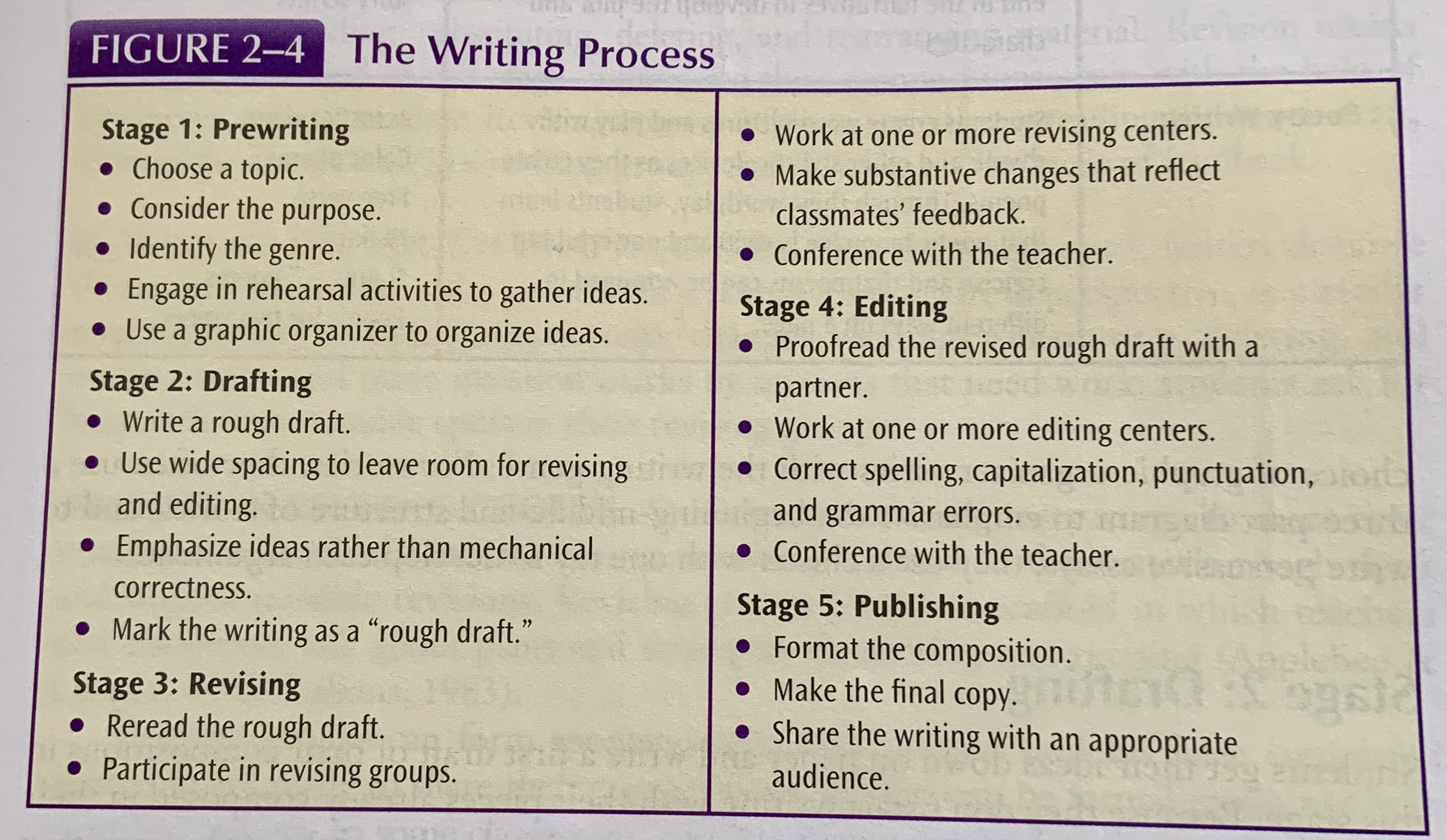
The writing process involves five stages. Although these stages are numbered 1-5, it is not a linear process. It usually involves recurring cycles. Students often merge and/or reoccur stages as they write. Figure 2-4 states all stages of the writing process and what happens in each stage.
Reading Strategies
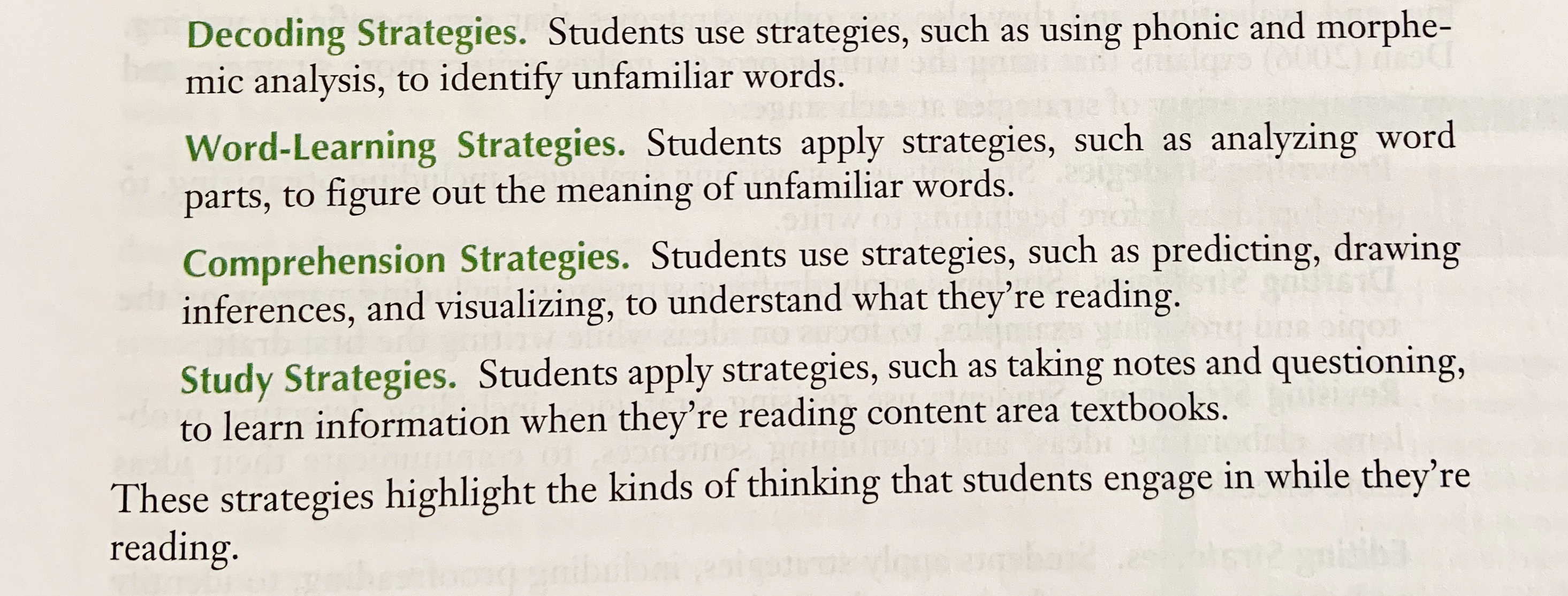
Comprehension strategies are the best known type of reading strategies, but students use strategies throughput the reading process. The image below states four types of strategies and what they entail.
Writing Strategies
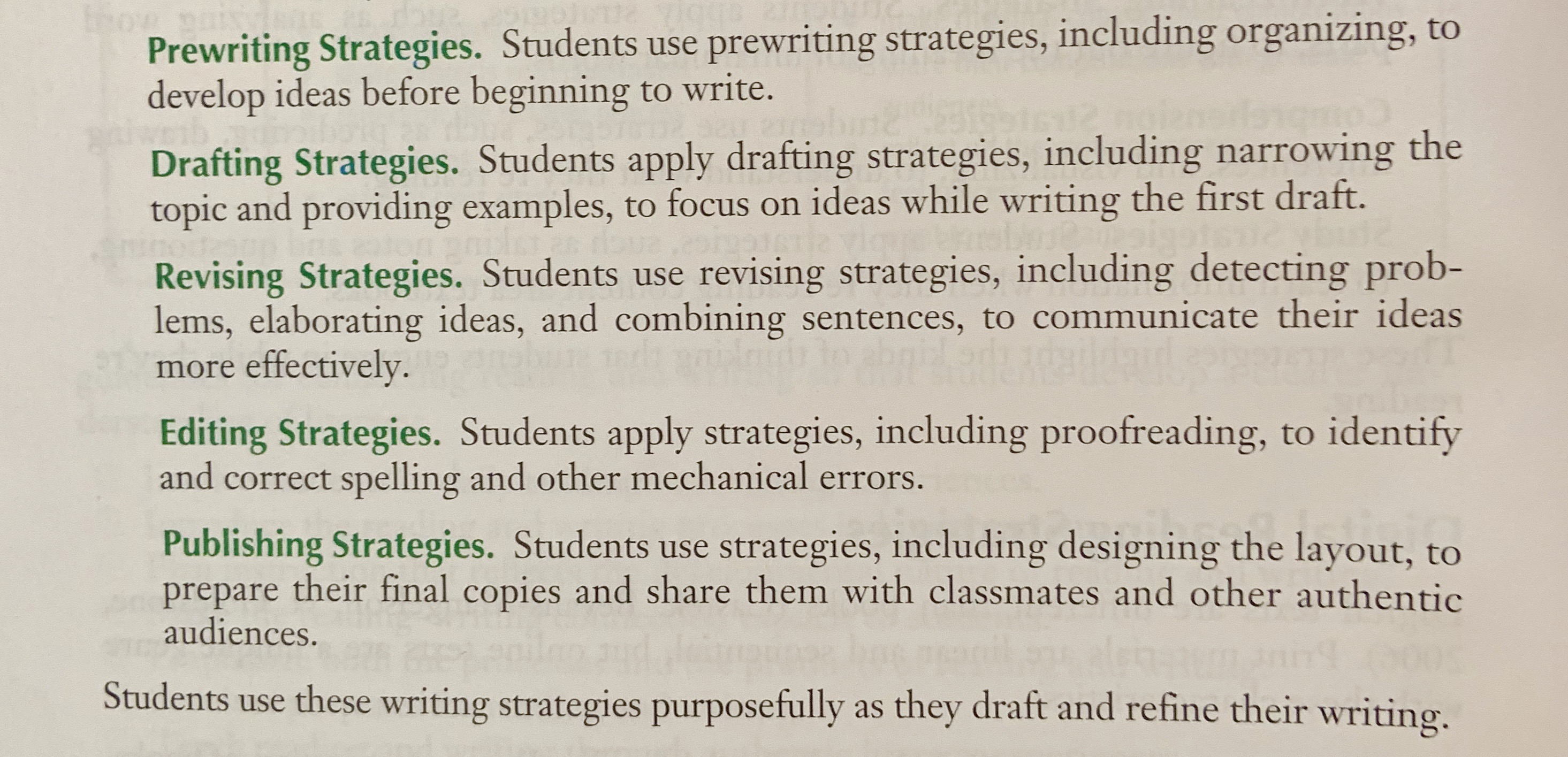
Writing strategies are tools students use deliberately to craft effective compositions. These are similar to reading strategies because they both activate background knowledge, question, repair, and evaluate and use other strategies specific to writing. The image below states five strategies and what they entail.
Classroom application
All of the aspects in this chapter will be implemented in my classroom. Reading and writing are two of the larges areas of content, especially in primary school. Reading activities usually involve writing. For example, when you read a passage most of the time there is some sort of written reflection of the text, or questions to answer afterwards. This also works the other way, writing activates usually involve reading. This can even be as simple as a student reading something they had just written.

 Payge Rivord