Payge Rivord EngEd 275-001
Four Steps of Assessment
Step One: Planning for Assessment
Teachers plan for assessment while planning for instruction. They think about questions while doing so, a few of these questions include:
- Are students struggling?
- Are students completing assignments?
- DO students have adequate background knowledge?
- Have students learned the concepts that have been taught?
By planning for the assessment before they begin teaching, teachers are prepared to use assessment tools wisely.
Step Two: Monitoring Students’ Progress
Teachers monitor students’ learning everyday and use the results to make instructional decisions. As they monitor students’ progress through observations, conferences, and other informal, formative procedures, teachers learn about students and their individual strengths.
Observations: effective teachers are “kid watchers”, a term used to describe “direct and informal observation of students”. To effectively observe, teachers must focus on what students do as they read of write, not focused on behavior. Observations should be planned and teachers usually observe certain students or groups on certain days so, throughout the week all students are observed.
Anecdotal Notes: These are brief notes that teachers write down as they observe students. They usually describe specific events and report observations, rather than evaluating observations.
Conferences: Teachers talk with students to monitor their progress as well as to set goals and help them solve problems. There are multiple ways to do this and they include: On-the-spot Conferences, Planning conferences, revising conferences, book discussion conferences, editing conferences, and evaluating conferences.
Checklists: Checklists simplify assessment and enhance students learning. Teachers identify the evaluation criteria in advance so students understand what is expected of them before they begin working.
Step Three: Evaluating Students’ Learning
Teachers document students’ learning to make judgement about their achievement. At this stage the assessment is usually summative. Tests are a traditional way to evaluate students’ learning but, teachers prefer to evaluate students’ actual reading and writing to make judgments about their achievement.
Rubrics: A set of guidelines and expectations for a specific project or assignment that assess the students work, these usually rank performance by numbers 1-5.
Step Four: Reflecting on Students Learning
Teachers reflect on their instruction to improve their teaching effectiveness. They ask themselves questions about lessons that were successful and those that weren’t and how they might adapt instruction to meet their students’ needs.
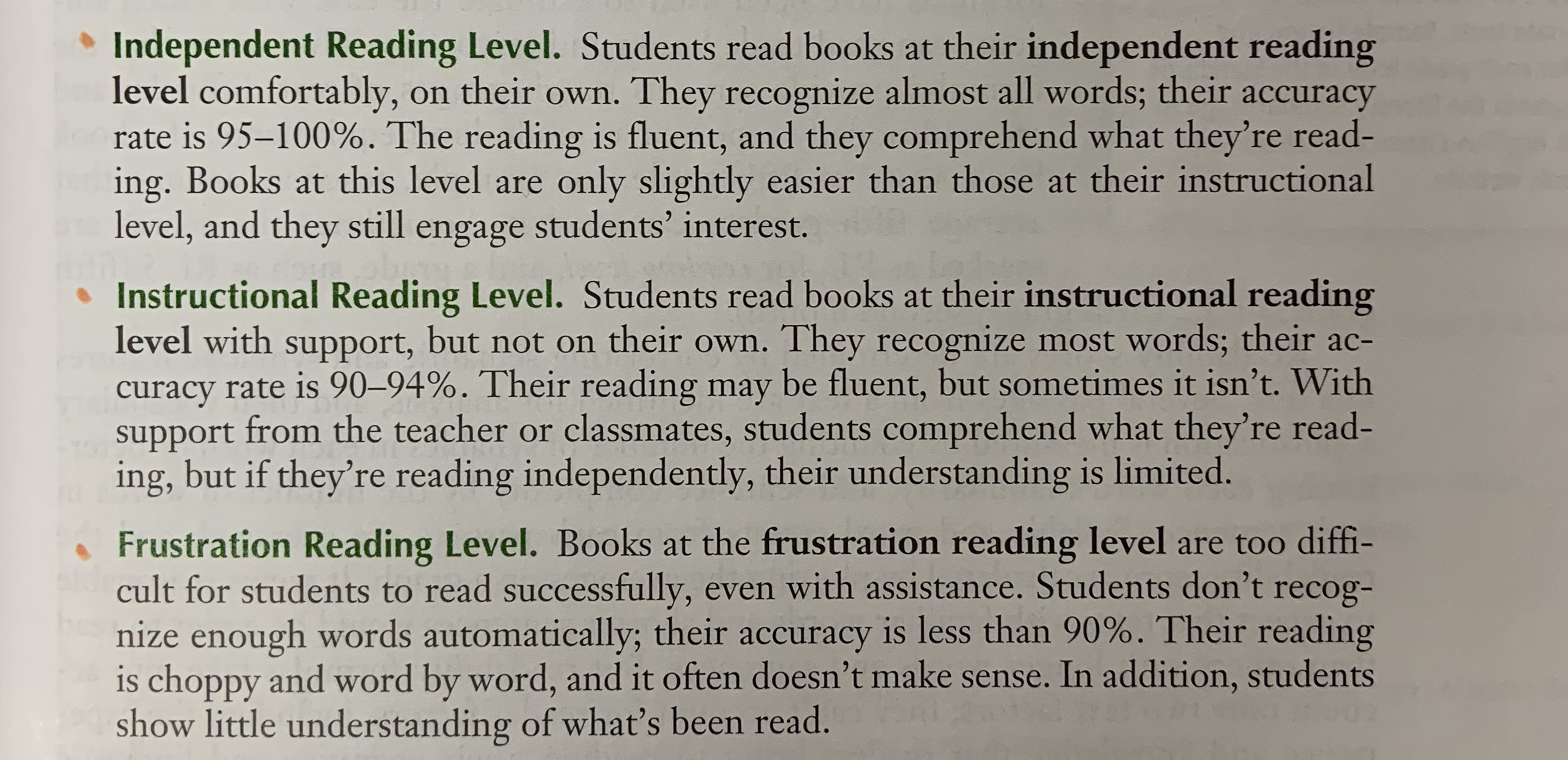
Three Reading Levels
Listed below are the three reading levels, along with a description.
SOLOM: An assessment tool many teachers use is the Student Oral Language Observation Matrix (SOLOM). This is a rating scale that teachers use to assess students’ command of English as they observe them talking and listening. It addresses the five components of oral language: Listening, fluency, vocabulary, pronunciation, and grammar.
Vocabulary for Chapter Three
- Running Records: A continuous record of a students oral reading to help identify errors made.
- Mini lessons: As teachers teach lessons about strategies and skills, they provide practice activities throughout the lesson and supervise as students apply what they’re learning.
- Book Talk: Students give book talks to their classmates. It is a presentation of the book where students share the book information, summarize, try to interest classmates to read that book.
- Portfolio: A portfolio is a collection of student work. Students and teachers use portfolios to evaluate the student and showcase their best work. Portfolios are systematic and meaningful collections of artifacts that document students’ literacy development and growth.
- Portfolio Assessment: In the process of making the portfolio, students learn to establish criteria for their selections. They also help teachers see patterns of growth and are used in parent-teacher conferences to supplement the information on the report card.
- Guided Reading: Students work in small groups with others who read at the same level. They do the reading themselves but, sometimes teachers will read the first few pages to help them get started. Guided reading sessions last about 25-30 minutes and teachers observe each individual student as they read. Teachers then use their observations to choose mini lessons and other books for students to read.
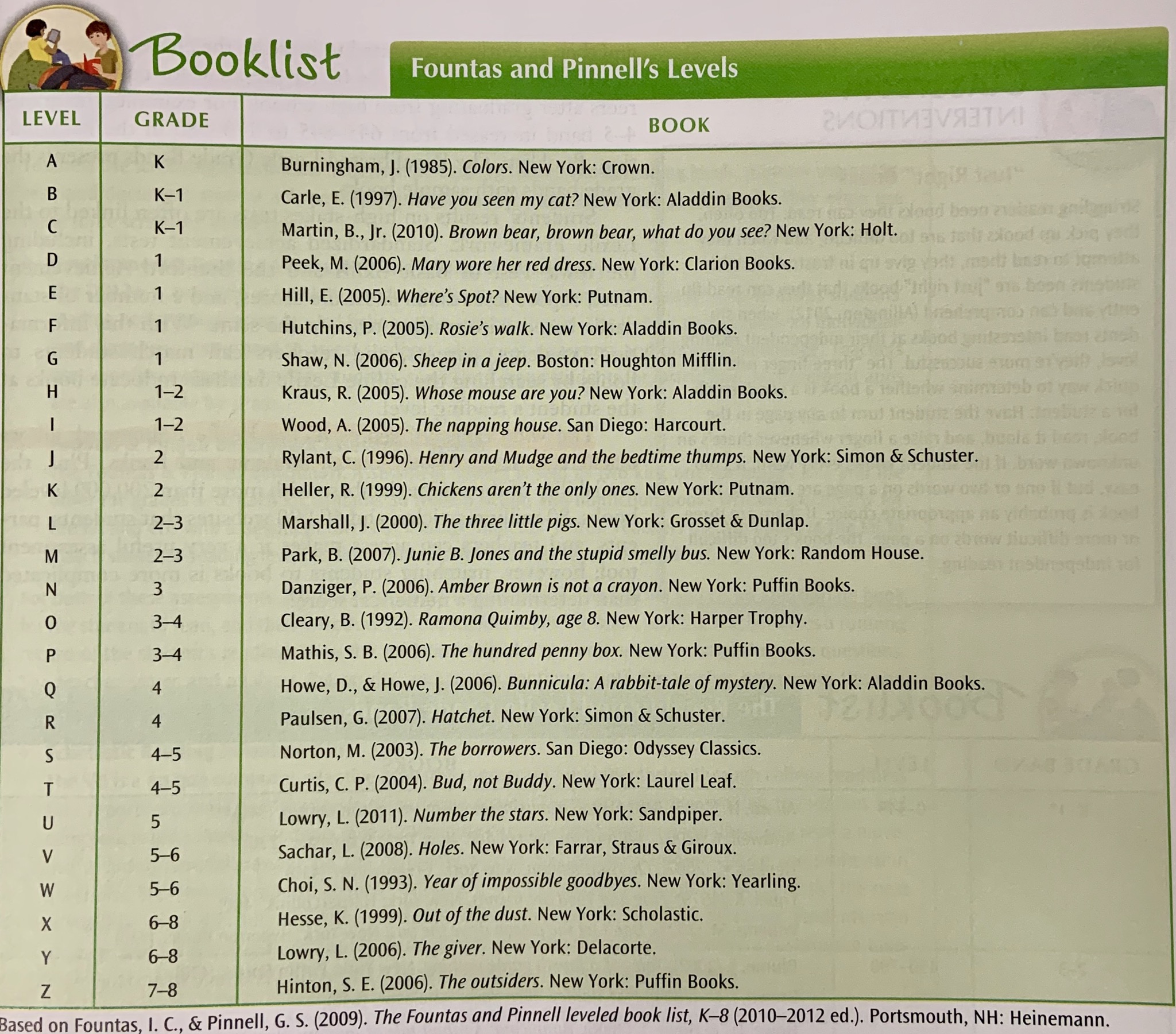
- Leveled Books: To match students to books in grades K-8, Fountas and Pinnell (2006) developed a text gradient, or classification system that arranges books along a 26 level continuum (A-Z) from easiest to hardest. Below is an image of a list of leveled books
Vocabulary Cont.
- Lexile Framework: This is a method of standardized testing that is used to measure both students’ reading levels and the difficulty level of books. Word familiarity and sentence complexity are two of the factors used to determine the difficulty level of books. Lexile scores range from 100-1300. These scores also coordinate with the Common Core Standards.
- Informal Reading Inventories (IRIs): these are commercial tests to evaluate students reading performance and are used from first to eighth grade but, are not as helpful in younger grades. These are often used a screening instrument to determine whether students are reading at grade level. They also serve as a diagnostic tool, helping to identify students who are struggling.
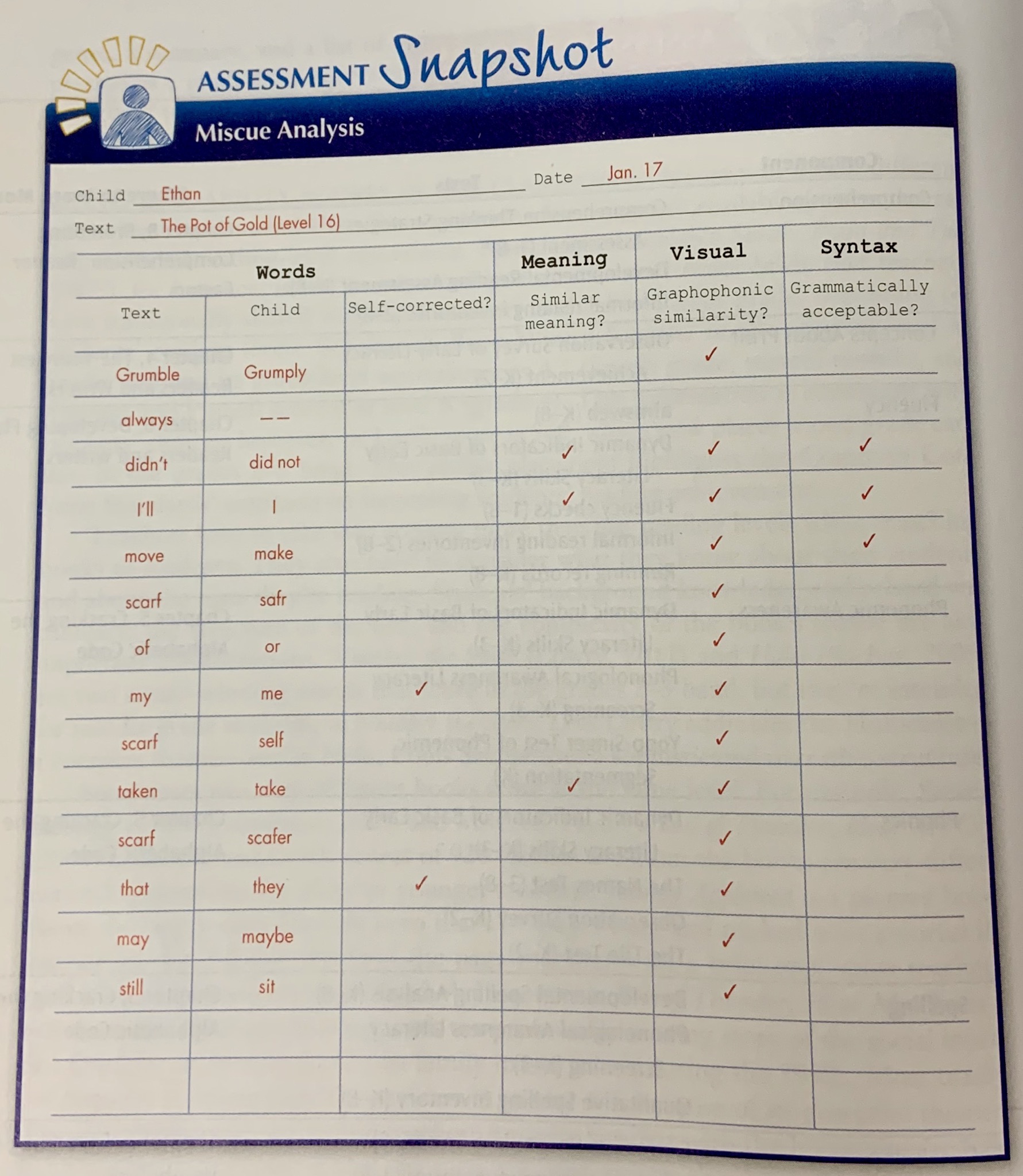
- Miscue Analysis: A miscue is a mistake made while reading aloud. A Miscue analysis is a procedure for categorizing and analyzing a students oral reading errors. The image below is an example of a miscue analysis.
- KWL Charts: A KWL chart stands for “Know” “Want to Know” and “What you learned” and it is a worksheet that students fill out before, during, and after a lesson. They also recently added another category at the end of this called “Want to learn”. It is a good way to bridge background knowledge with content.
- High-Stakes Testing: These are tests that are designed to objectively measure students knowledge according to grade-level standards. These tests usually have consequences for poor performance and this creates an anxiousness and nervousness. Students tend to feel a lot of pressure when taking a high stakes test. These scores provide little information for day-to-day instructional decisions but, students, teachers, and administration are help accountable by the results.
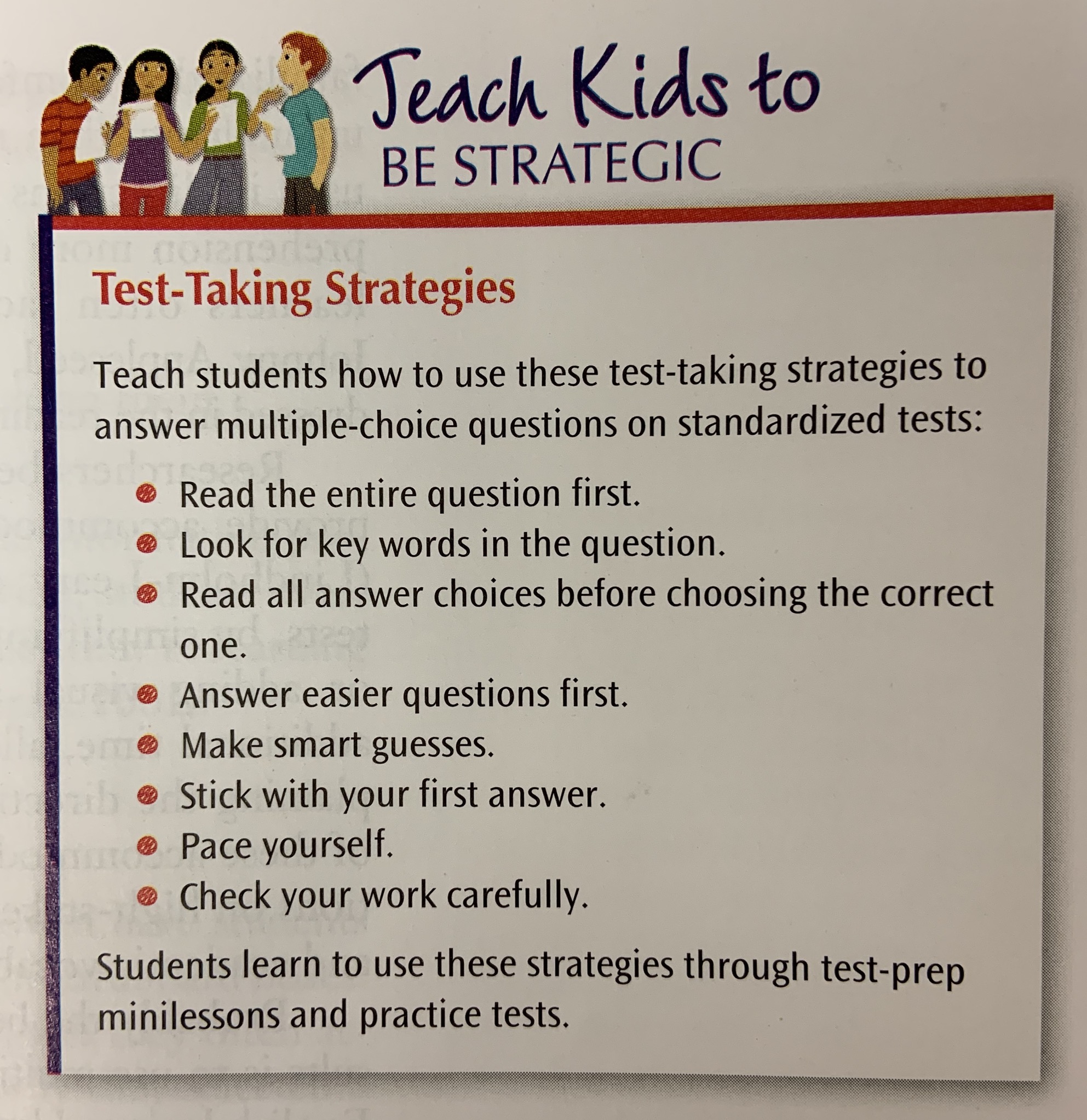
Test-taking strategies
Lesson Plans
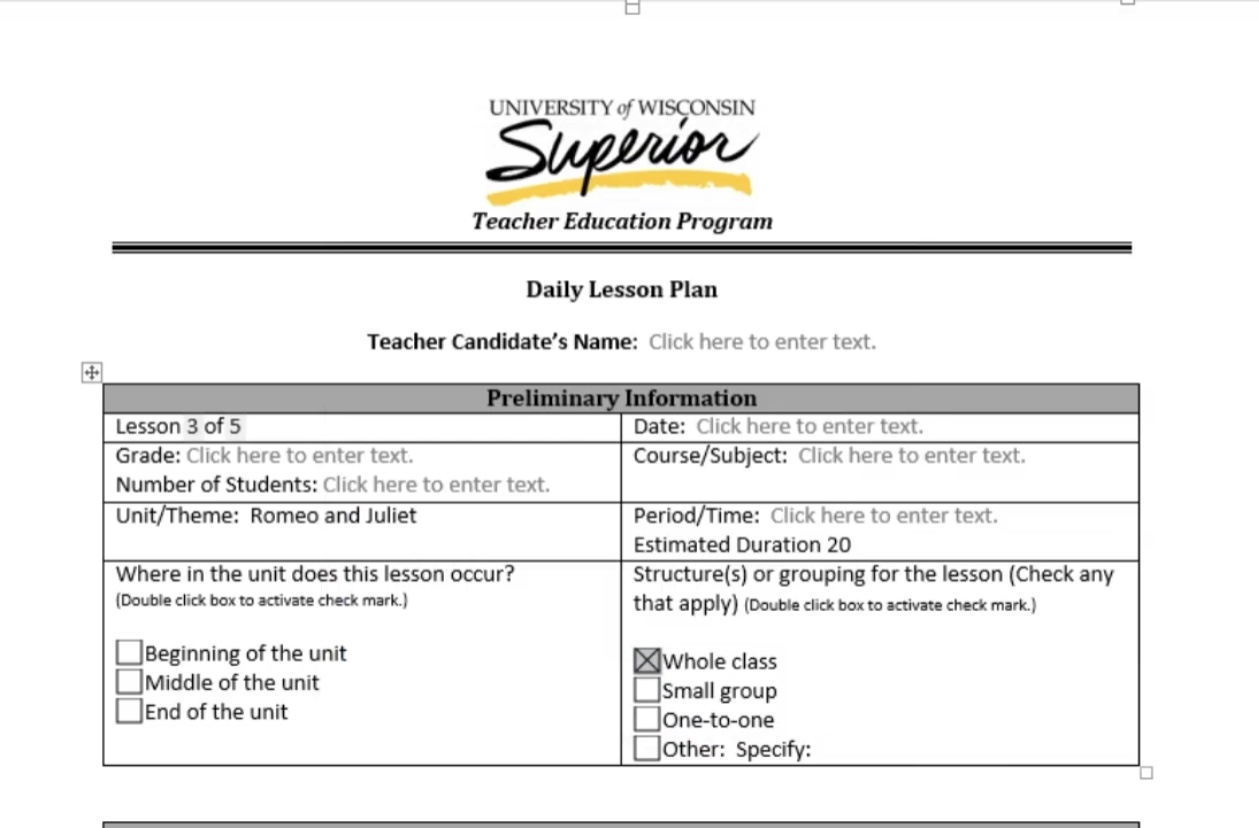
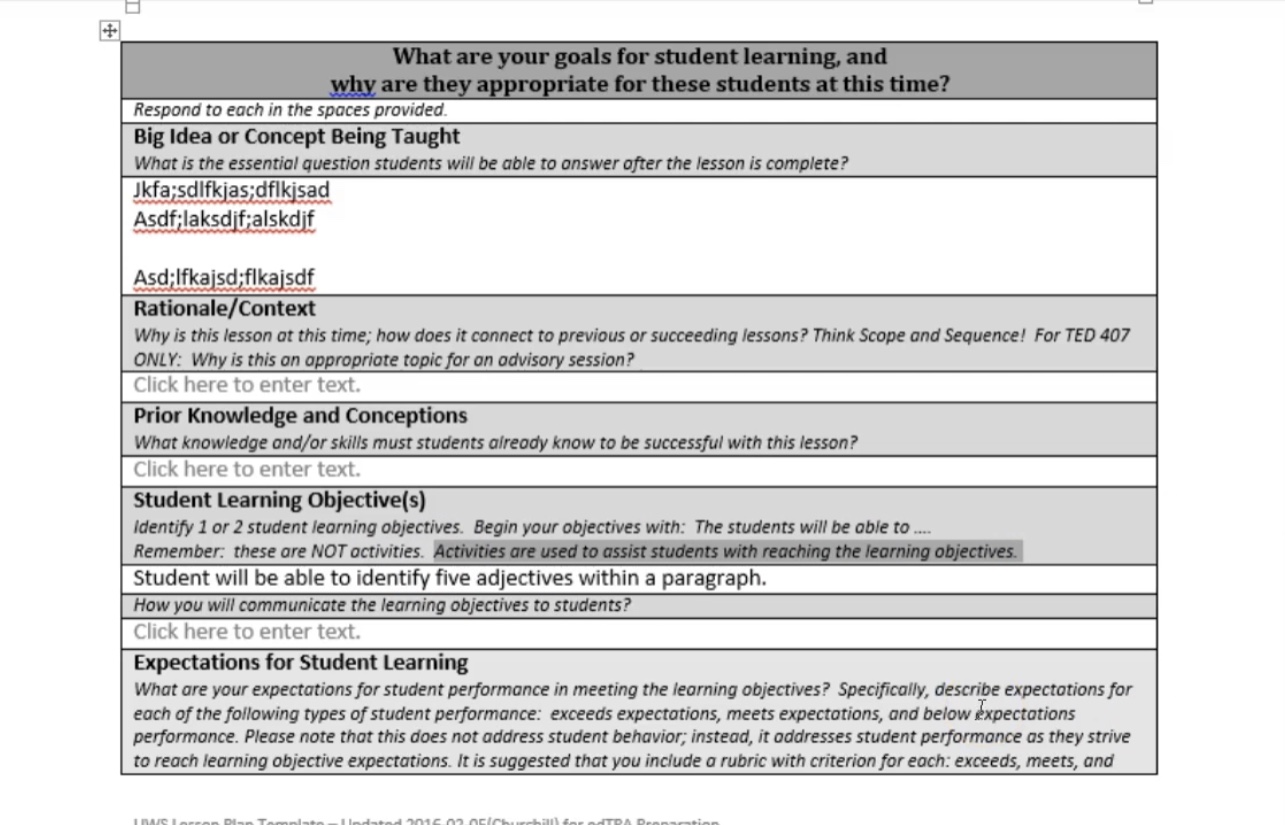
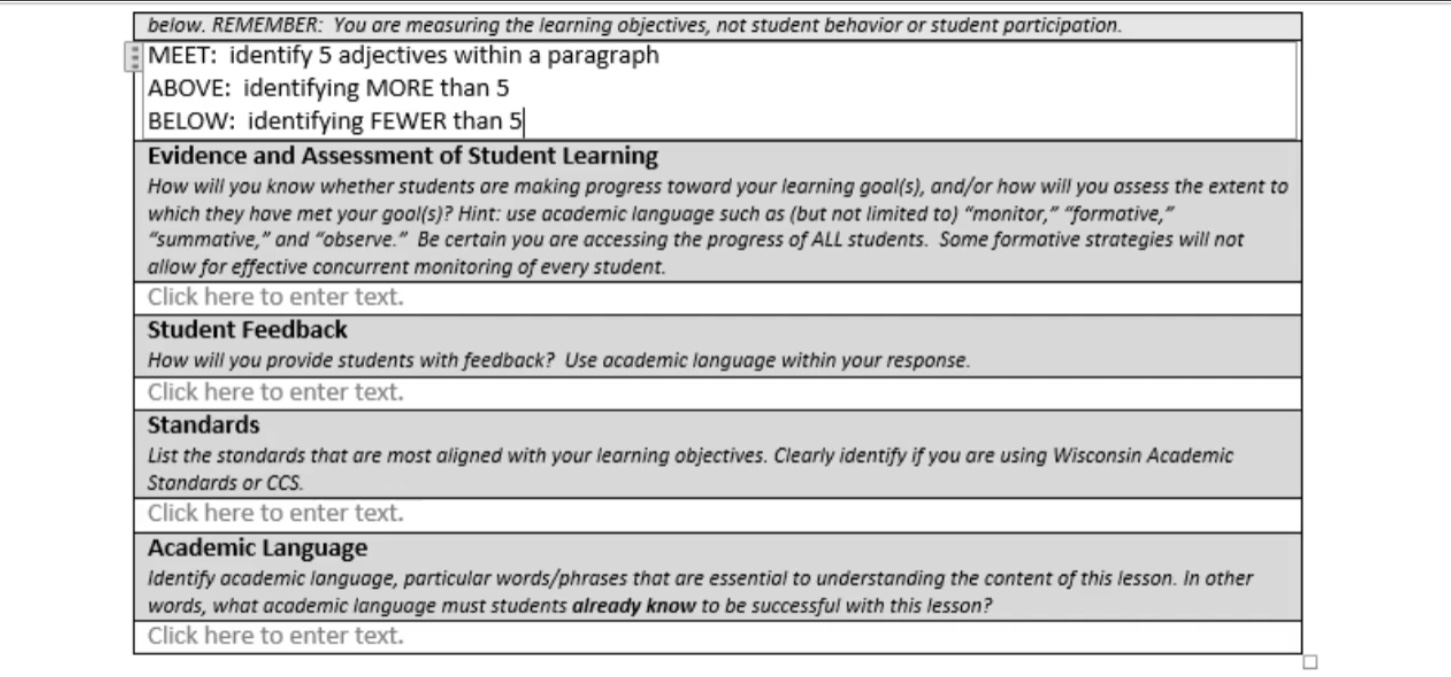
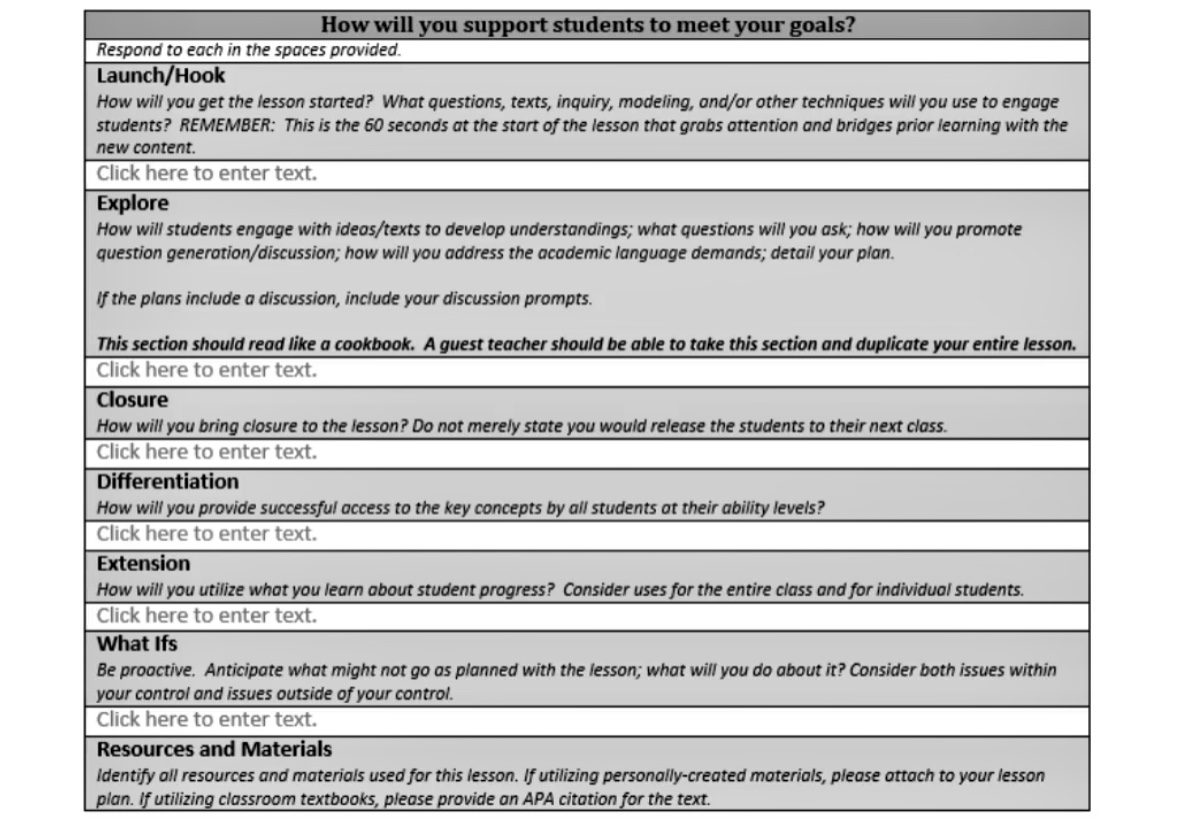
At UWS, most of the education department professors require students to use the lesson plan template. This template has four sections, covering the different aspects of creating a lesson.
Classroom Application
As future teachers, we always want to be observant and continuously evaluating our students. This is something I will strive for in my class but, it also comes naturally. I tend to watch people, their mannerisms, body language, tone, etc. I notice patterns in people and also noticed when those patterns as disturbed. This skill will really benefit me while attempting to implement observations of 20+ students. I also figured out that I tend to use anecdotal notes myself already. I’m somewhat forgetful so, I try to write things down as soon as they happen. This will make taking anecdotal notes in class almost like habit.

 Payge Rivord