Creating Learning Objectives
learning objectives are general statements of desired learning. They are specific statements. Learning objectives are also student-centered and are specific learning targets for students. They describe outcomes – NOT activities. They should state what is to be accomplished by students at the end of a lesson and the outcome should be appropriately challenging. These are written in a specific and purposeful way that guides teacher lesson planning and communicates daily student learning outcomes.
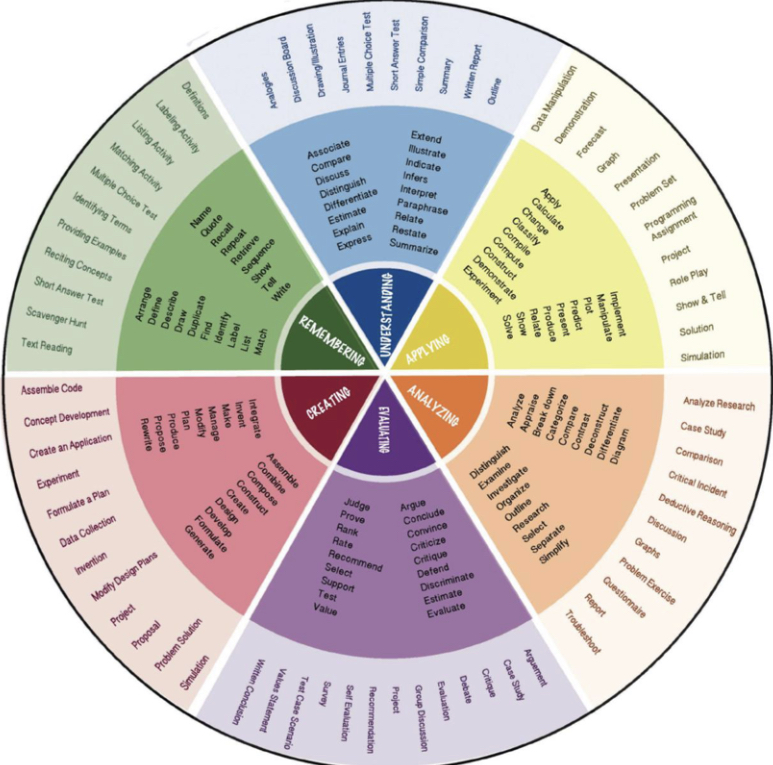
The acronym “S.M.A.R.T.” is used to make sure learning objectives are: Specific, Measurable, Attainable, Relevant/Results-oriented, and Time-bound. SMART learning objectives use Bloom’s Taxonomy of learning domains. Attached below is a picture of the “modern” version of Bloom’s Taxonomy. The words connected to the Taxonomy are essential as the verbs of SMART learning objectives.
There are also verbs you should not use called “Weasel Words”. These words are not measurable or specific. They include verbs like: learn, see, imagine, understand, appreciate. etc.
Non-example of a student-centered learning objective:
- Students will hear a lecture on graphing linear equations.
Correct example of a student-centered learning objective:
- After observing a lecture with examples, students will graph linear equations.
These examples differ because the non-example is stating what the students will be doing. The correct example states what the students will be able to do after.
Chapter Four
Concepts About Print
Through experiences in their homes and communicates, young children learn that print carries meaning and that reading and writing are used for a variety of purposes. They learn meaning by noticing things such as menus or receiving/writing letters. Children’s understanding about the purposes of reading and writing reflects how written language is used in their community. This varies from community to community because they vary the way they use language.
Concepts About Words
At first, young children only have vague notions of literacy terms such as: word, letter, sound, and sentence but, they develop an increasingly sophisticated understanding of these terms. There is four levels to this. the first level is having a vague notation and don’t differentiation between words and things. The second level is when they can describe words as labels for things. children consider words that stand for objects as words but, thy don’t classify articles and prepositions as words because words such as: the and with, because they can’t be represented by objects. The third stage level is when children can understand that words carry meaning and stories are built from words. The last level is when more fluent readers can describe words as autonomous elements, having meaning of their own with definite semantic and syntactic relationships.
Concepts about the Alphabet
Young children also develop concepts about the alphabet and how letters are used to represent phonemes. Components of letter knowledge include:
- Letter names
- Formations of letter in upper and lowercase manuscript handwriting
- features of letter that distinguish it from other letters
- directions the letter must be turned to distinguish it from other letters
- use of the letter in known words
- sound the letter represents in isolation
- the sound the letter represents in combination with others
- the sound the letter represents in the context of a word
Children use this knowledge as the read to decode unfamiliar words as they read and to create spellings for words as they write. Inserted below is a list of routines for teaching the alphabet.

Assessing Concepts of Written Language
Teachers regularly observe children as they look at books and reread familiar ones to monitor their developing knowledge about written language concepts. They notice which concepts children understand and which ones they need to continue to talk about and demonstrate during shared reading.
Shared Reading: Teachers read aloud books and other texts that students could not read independently. Often teachers use big books so that all students can see the text and read along. This differs from reading aloud because students can see the text as the teacher reads. Students will often join in the reading aloud of repeated phrases or rhymes.
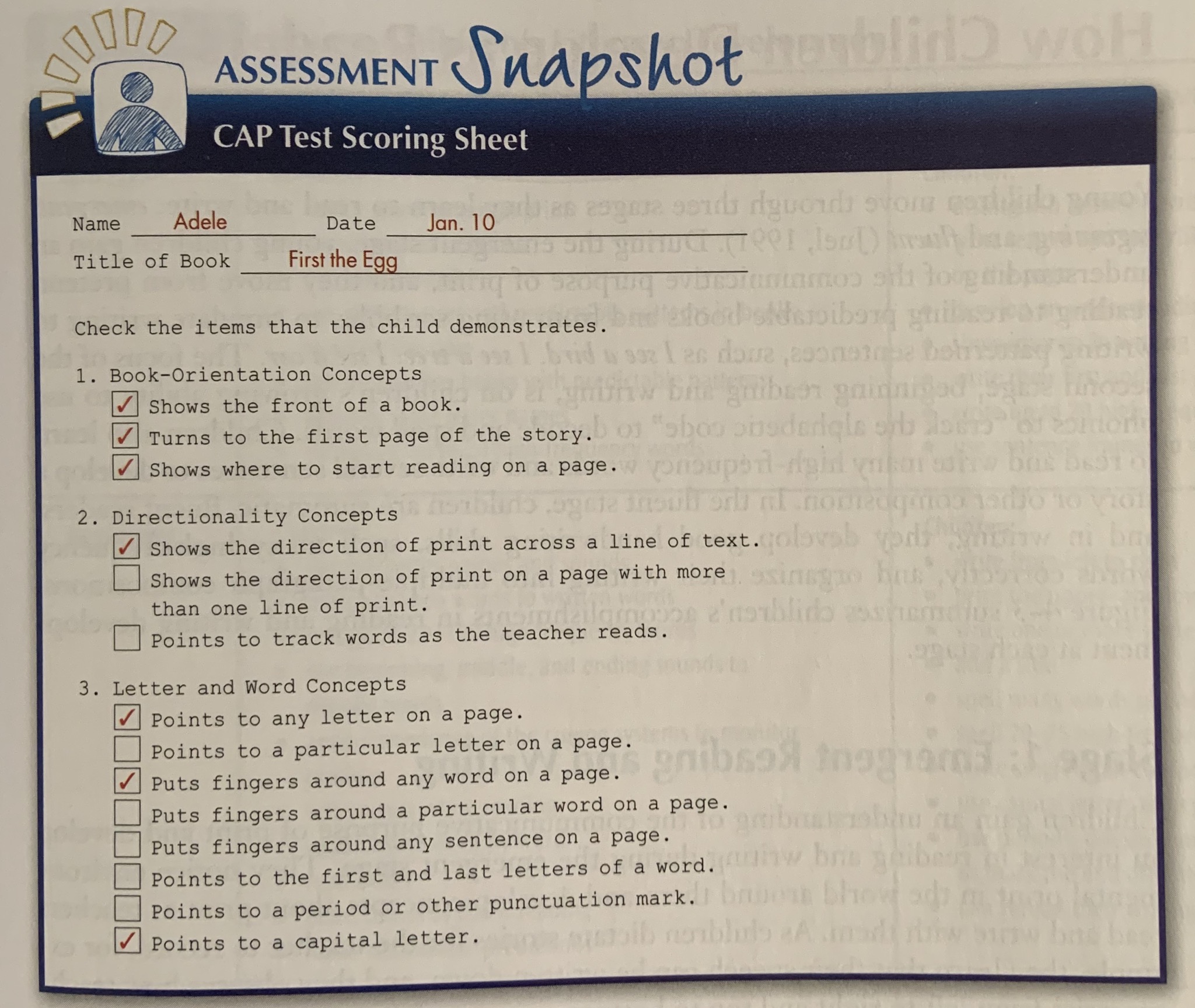
Teachers use the Marie Clay’s Concepts About Print (CAP) test and create their own versions of the test to assess young children’s understanding of written language concepts. Below is an example of a CAP test:
Language Experience Approach (LEA)
LEA is based on children’s language and experiences. In this approach teachers use shared writing: students dictate words and sentences about their experiences and the teacher writes down what the students say; the text they develop become the reading material. Because the language comes from the children themselves and because the content is based in their experiences, they’re usually able to read the text easily.
Emergent, Beginning, and Fluent Reading and Writing Levels
The image below describes what each stage looks like for both reading and writing.

Morning Message
A daily literacy routine that teachers use to teach literacy concepts, strategies, and skills. The teacher writes a brief message on chart paper, usually in the form of a friendly letter, about what will happen that day; then the message is read at the beginning pf the school day. Afterward, children reread it and count the letters, words, and sentences in the message. Depending on their level of literacy development, they also pick out familiar letters and words, words following a particular phonics patter, high-frequency words, or capital letters, and punctuation marks. A couple types of morning messages are a fill-in-the-blank morning message, where teachers read the letter with the blank spaces and during the second reading, children identify the missing words. Another type is when one student dictates a message to share with the class, where the children take turns dictating a message to share with classmates. The last type is when the children collaboratively create the morning message. This is done at the end of the day and the teacher and students discuss what they did that day and, what to write in their letter.
Vocabulary for Chapter Four
- Environmental print: Young children begin reading by recognizing logos on fast food restaurants, department stores, grocery stores, and commonly used household items within familiar contexts. They recognize the golden arches of McDonald’s and say “McDonald’s!” but, when they are shown the word McDonald’s written down without the familiar sign, they can’t read it.
- Revising Groups: Children share their rough drafts of writing in groups of four of five. Sometimes teachers join in but, usually students run the group themselves. They take turns reading their rough drafts to each other and listen as their classmates offer complements and suggestions for revision.
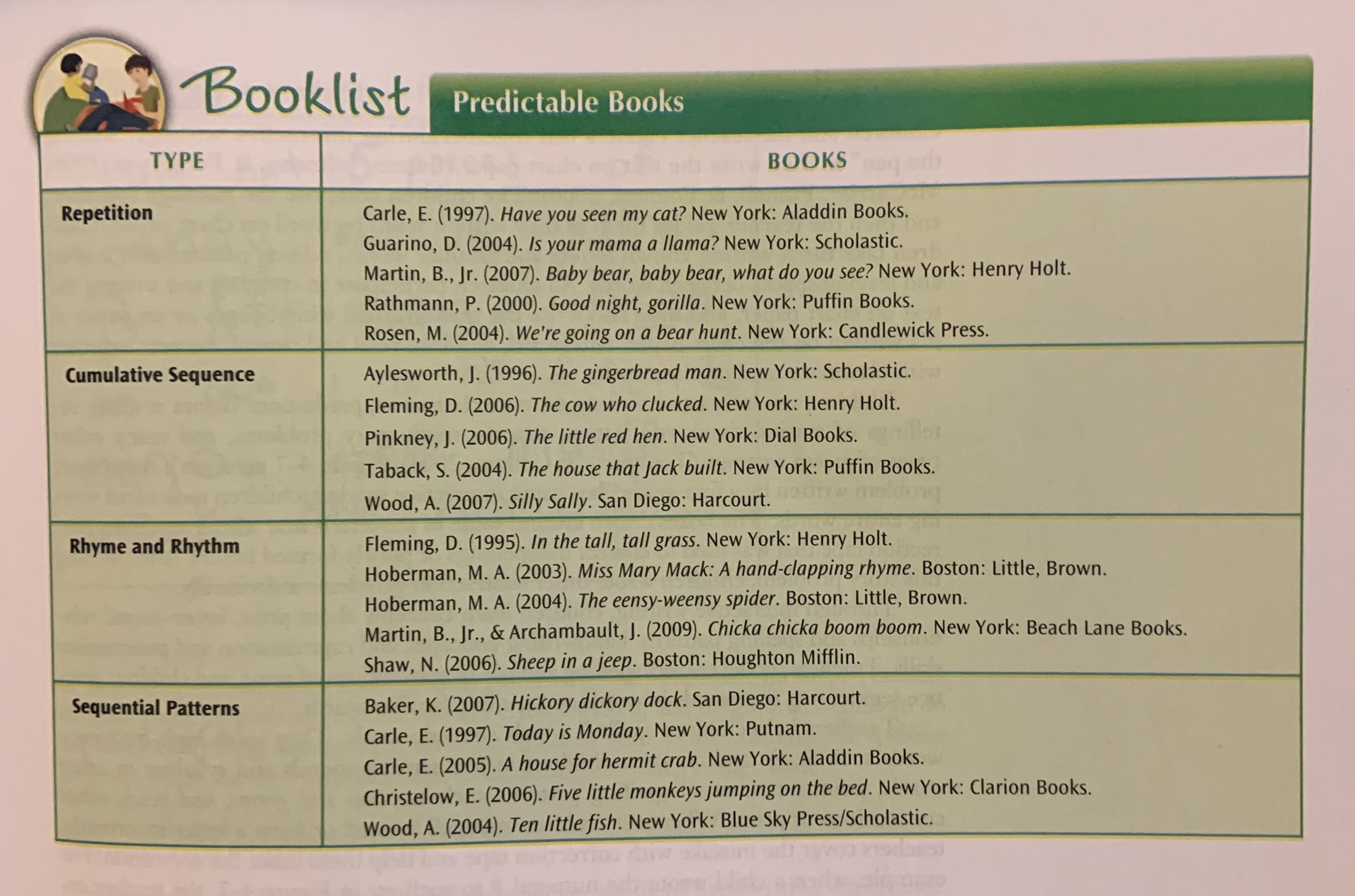
- Predictable Books: Books that often have repeated sentences, rhyme, or other patters. Teachers use these for shared reading. There are four common types of predictable books, and they are listed below, along with books that use each one.
Vocabulary Cont.
- Interactive Writing: Children collaboratively create a message together and the teacher guides them as they write it word for word (taking turns) on chart paper.
- Manuscript Writing: In kindergarten this focuses on developing children’s ability to hold pencils, refining their fine motor control, and focusing on letter formation. After they learn this, they focus on refining and perfecting their handwriting. Manuscript essentially means handwriting.
- Interactive Reading: teachers model comprehension skills by reading and thinking out loud for their students. Engaged readers then use the same interactive skills their teachers have demonstrated to comprehend their own texts.
- Choral Reading: Students take turns reading lines of a poem or story. The students support one another by actively participating and sharing the work.
- Guided Reading: Students work in small groups with others who read at the same level. They do the reading themselves but, sometimes teachers will read the first few pages to help them get started. Guided reading sessions last about 25-30 minutes and teachers observe each individual student as they read. Teachers then use their observations to choose mini lessons and other books for students to read.
- Word wall: Students and teachers add important words to a “word wall”. Students can then reference these words while doing word-related activities.
- Mini lessons: As teachers teach lessons about strategies and skills, they provide practice activities ans supervise as students apply what they’re learning.
- Interactive Read-Aloud: An activity where students engage in listening and talking about/discussing the text throughout a read-aloud, instead of before and/or after. The teacher may read aloud a page or, a few pages, and stop to discuss key ideas, illustrations, or other text features that will aid comprehension, make connections to other texts, and/or confirm/dis-confirm prior predictions.
Classroom Application
I really enjoyed the idea of a morning message. These two morning message ideas stood out to me: collaborative morning messages and morning messages dictated by an individual student. A collaborative message would give the children a great chance to discuss and create something as a group. A Message created by an individually student would give them a chance to be in the spotlight and showcase their own work. Both of these are great morning message ideas and I want to use both of these in my future classroom.

 Payge Rivord