Payge Rivord EngEd 275
Vocabulary
- Phonemes: The smallest unit of sound in a word.
- Graphemes: letters or letter combinations.
- Graphonemic: the recognition of letters and the understanding of sound-symbol. relationships and spelling patterns; its often referred to as phonics.
- Phonemic Awareness: the parts of sound in a word.
- Phonics: anything in writing.
- Consonant Digraph: two consonants make a combination, representing single sounds that aren’t represented by either letter. the letters some together to create a unique sounds such as /ch/, /sh/, or /st/.
- Dipthong (vowel digraphs): two vowels represent a glide from one sound to another, like oi or oy.
- R-controlled (bossy R) vowels: when one or more vowels are followed by an R, the R influences the pronunciation of the vowel sound.
- Onset: the consonant sound (if any) the precedes the vowel. Ex. Sh [ow]
- Rime: is the vowel and any consonant sounds that follows the onset. Ex. [sh] ow
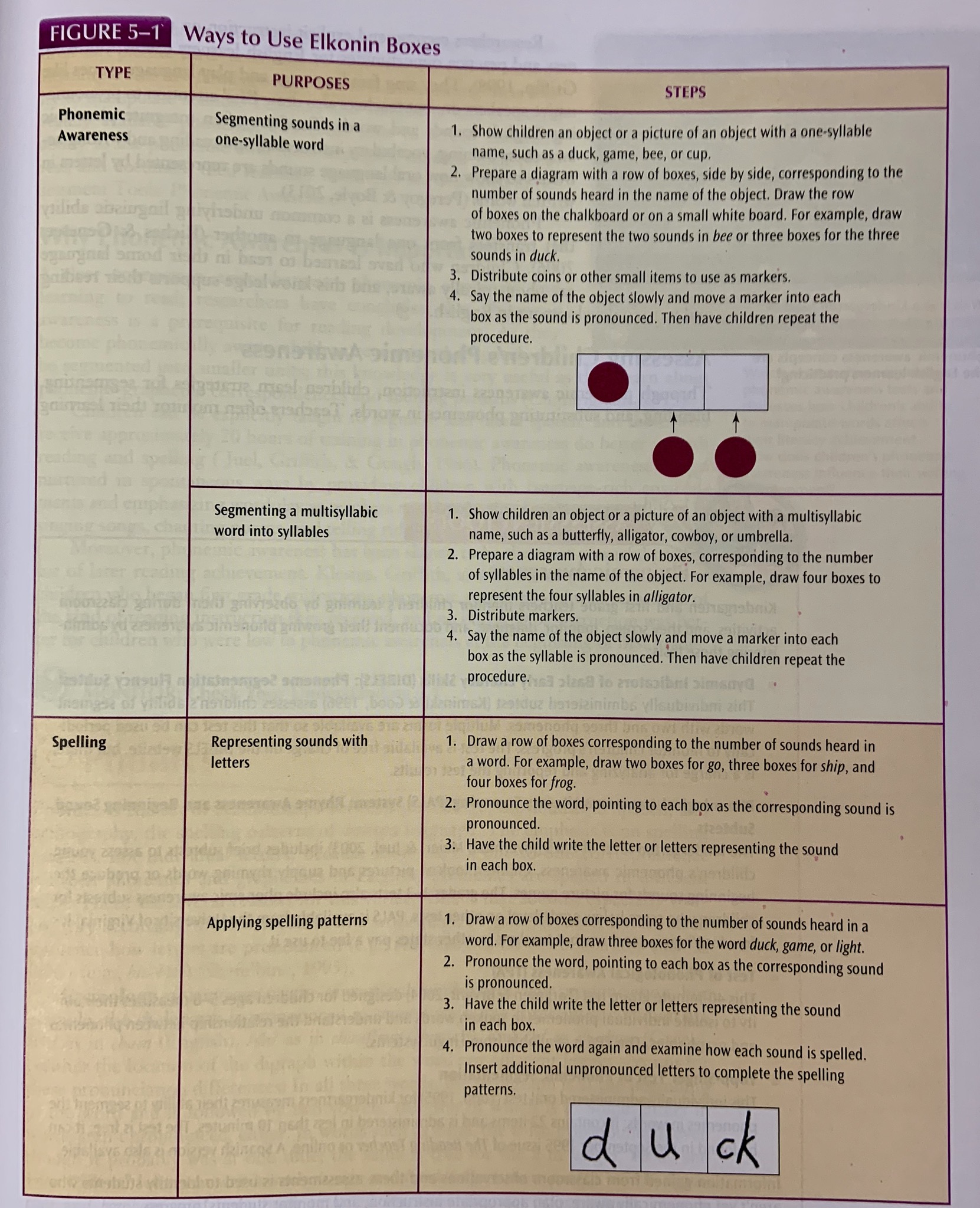
- Elkonin Boxes: the teacher shows an object or a pictures of an object and draws a row of boxes, with one box for each phoneme in the name of the object or picture. then the teacher or a child moves a marker into each box as the sound is pronounced. this is not for syllables, this is for sounds. For example: BEE would only need to boxes for /B/ and /ee/. Below is an example of how we use Elkonin Boxes
Teaching Phonics
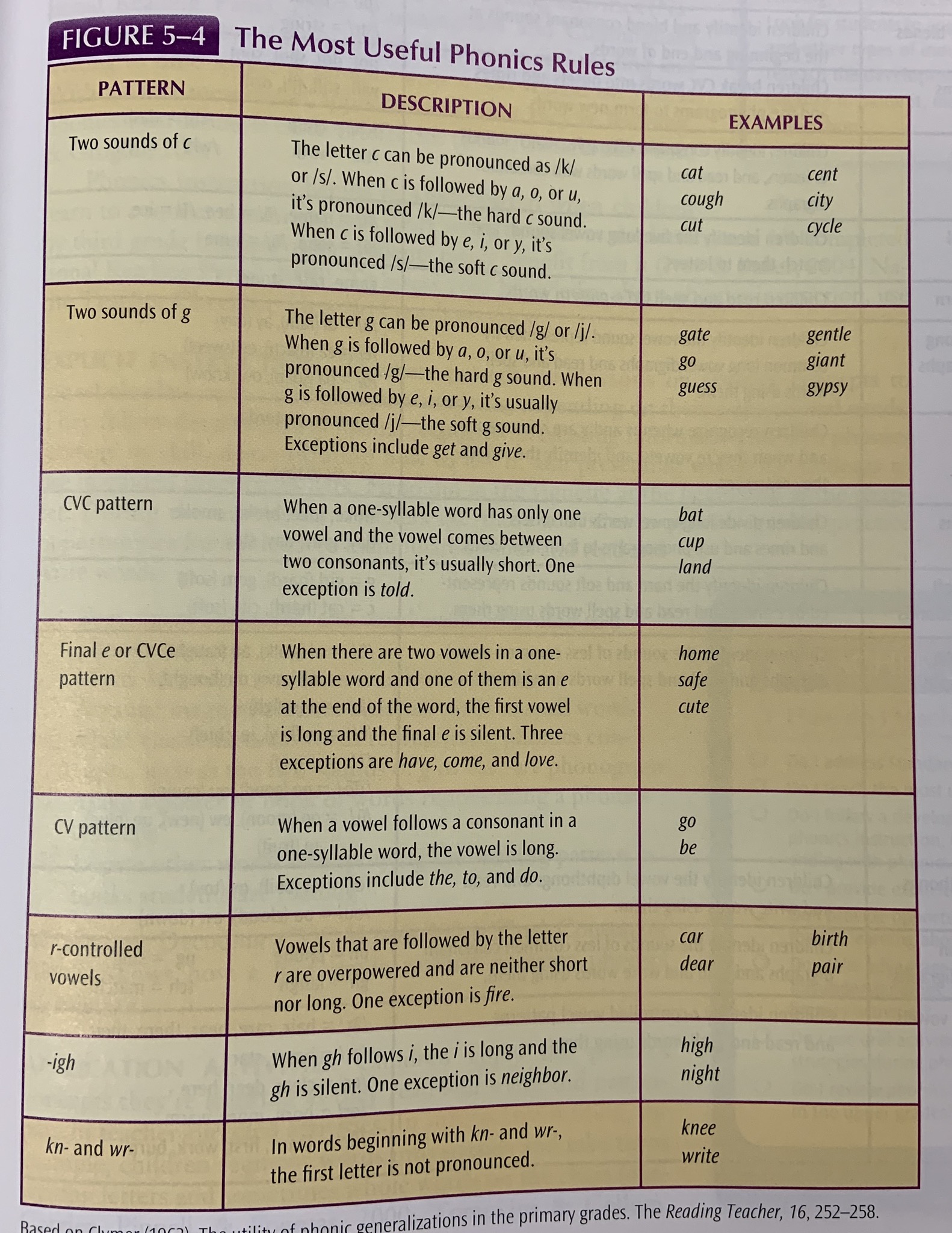
The best way to teach phonics is through a combination of explicit instruction and authentic application activities. The most useful phonics skills are taught in a predetermined sequence. Most teachers begin with consonants and then introduce the short vowels so that children can read and spell consonant-vowel-consonant (CVC) words, such as dig or cup. The learning continues in a scaffold, the image below shows all the steps after CVC words.
Phonemic Awareness Strategies
the image below states phonemic awareness strategies

Teaching Phonemic Awareness
Teachers nurture children’s phonemic awareness through the language-rich environments they create in their classroom. They sing songs, chant rhymes, read aloud wordplay books, and play games; children have many oppurtunities to orally match, isolate, blend, and subsititute sounds and to segment words into sounds.
Phonemic awareness instruction should meet three criteria:
- The activities should be appropriate 5- and 6-year old. Activities involving songs rhymes, riddles, and wordplay books are good choices because they encourage children’s playful experimentation with oral language.
- The instruction should be planned and purposeful, not just incidental. Teachers need to choose instructional materials and plan activities that focus on the children’s attention on the sound structure of oral language.
- Phonemic Awareness activities should be integrated with other components of a balanced literacy program. It’s crucial that children percieve the connection between oral and written language.
Here is a list of book that are helpful with phonemic awareness activities and instruction.

Teaching Spelling
One of the best ways to teach spelling is through weekly spelling tests but, tests should never be considered a complete spelling program. To become good spellers, children need to learn about the English orthographic system and move through the stages of spelling development. They develop strategies to use in spelling unknown words and gain experience is using dictionaries and other resources. A complete spelling program includes:
- teaching spelling strategies
- matching instruction to students’ stage of spelling development
- providing daily reading and writing opportunities
- teaching students to spell high-frequency words
Important spellings strategies include:
- segmenting the word and spelling each sound, often called “sound it out”
- spelling unknown words by analogy to familiar words
- applying affixes to root words
- proofreading to locate spelling errors in a rough draft
- locating the spelling of unfamiliar words in a dictionary
Classroom Application
One of the biggest things this I can take away from this chapter is the book list it gives, to help with phonemic awareness. I plan to save all the given book lists and tentatively plan to use them in the classroom. This is a great resource that is just given and you don’t need to search for.

 Payge Rivord