Vocabulary for Chapter Seven
- Word consciousness: students interest in learning and using words.
- Synonyms: words that have nearly the same meaning as other words. They are useful because they are more precise.
- Antonyms: Words that express opposite meanings
- Homophones: Words that have different meanings and different purposes, but they’re either spelt or pronounced the same.
- Etymologies: Etymologies are word histories. Glimpses into the history of the English language offer very interesting information about word meanings and spellings. Even though words have centered English from around the world, the three main sources of words are English, Latin, and Greek.
Three Tiers of Words
- Basic words: these are common words that are used socially, in informal conversation at home or with friends. Examples: animal, clean
- Academic vocabulary: words that are frequently used in language arts, social studies, science, and math. These are found in books and textbooks that students read; teachers use them in mini lessons, discussions, and assignments because students are expected to understand them in high-stakes testing. Examples: paragraph, preposition
- Specialized terms: these are technical words that are content specific and often abstract. These aren’t used frequently enough to devote time to teaching them, but they’re the words that teachers explicitly teach during thematic units and in content area classes. Examples: minuend, osmosis
Levels of Word Knowledge
Students develop knowledge about a word gradually, through repeated oral and written exposure to it. They move from not knowing a word st all to recognizing that they’re seen the word before, and then to a level of partial knowledge where they have a general sense of the word or know the meaning. Finally, students know the word fully: they know multiple meanings of the word and can use it in a variety of ways. Below are these four levels fully explained.


Multiple Word Meanings
Many words have more than one meaning. For some words, multiple means develop from the noun and verb forms, but sometimes additional meanings develop through wordplay and figurative language. Example: The definition of Bank:
- A piled up mass of snow
- A place that safely hold your money
- The slope of land beside a lake or river
- Many more
Root Words and Affixes
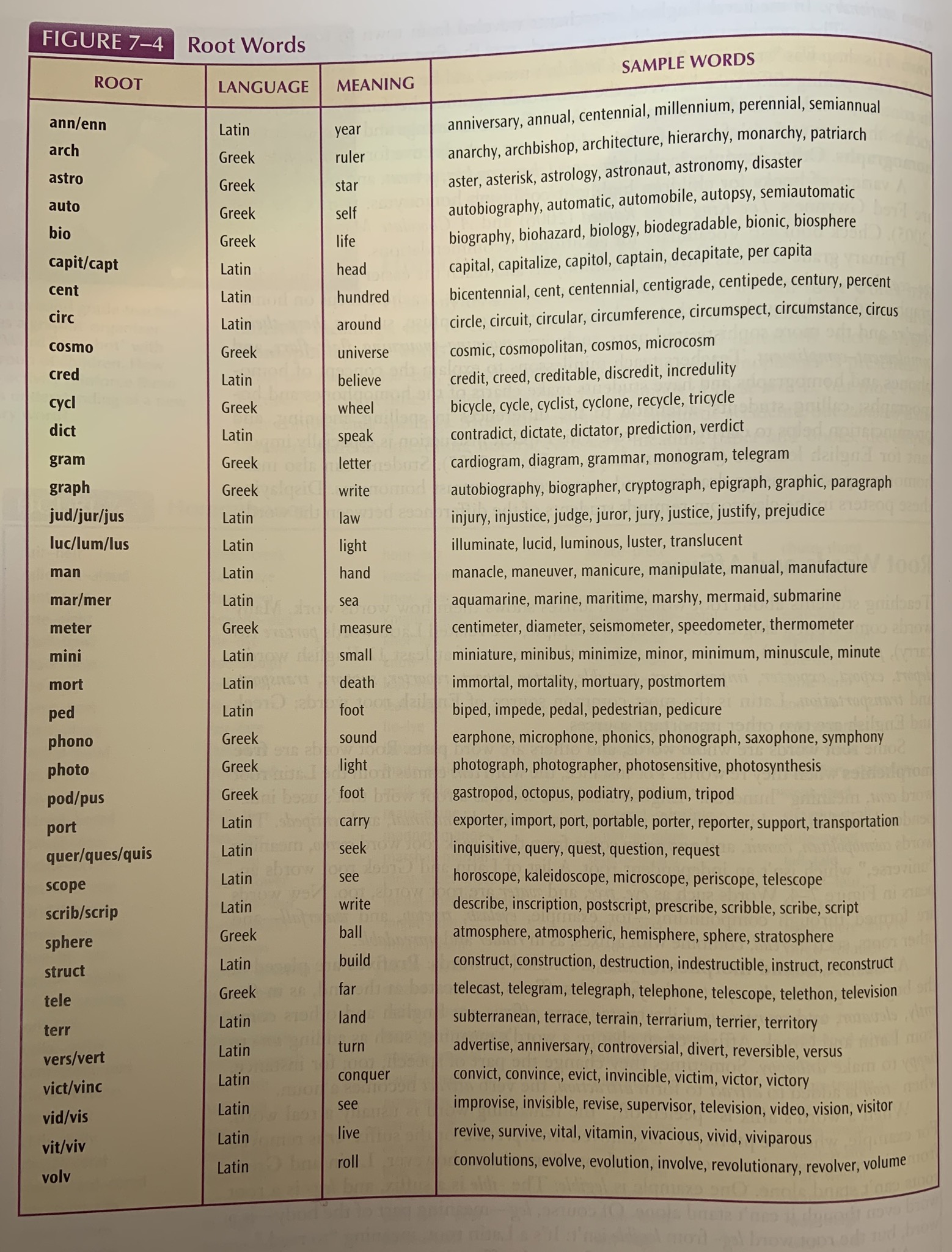
Teaching students about root words and affixes shows them how words work. Many words come from a single root word. Latin is the most common source of English root words, along with Greek and English. Some root words are whole words, and others are word parts. Root words are free morphemes when they’re words. English treats a root word as a word that’s used independently and in combination with affixes. Example: Cent May stand alone but the root word cosmo is not independent. Affixes are used in combination with root words and cannot stand alone. Example: century – cent is the root word and ury is the affix.
Affixes are bound morphemes that are added to root words. They come in two forms: prefixes and suffixes. Prefixes are placed at the beginning of a word and suffixes are places at the end of the word. Nether prefixes or suffixes are independent. Below is a list of common root words.
Vocabulary Instruction
Vocabulary instruction plays an important role in balanced literacy classrooms because of the crucial role it plays in both reading and writing achievement. Below are the most effective ways to teach vocabulary.

Explicit Instruction
Teachers explicitly yeah students about academic vocabulary, usually tier 2 words. Instruction should be rich, deep, and extended. Which means teachers provide multiple encounters with words; and involve students in words. The procedure is time consuming, but researchers report that students are more successful in learning and remembering word meanings this way.
Word Study Activities
Students examine new words and think more deeply about them as they participate in word-study activities. These include word posters, word maps, possible sentences, dramatizing words, word sorts, word chains, and semantic feature analysis.


Word Learning Strategies and How to Figure out Unfamiliar Words
When students come across an unfamiliar word while reading, they can do a variety of things: reread the sentence, analyze root word, sound out the word, etc. Some techniques, however, work better than others. These three strategies have been identified as the most effective:
- Using contextual clues
- Analyzing word parts
- Checking a dictionary
Capable readers know and use these strategies to figure out the meaning of unfamiliar words as they read. In contrast, less capable readers have fewer strategies available: they often rely on one or two less effective strategies, like sounding it out or skipping it.
How to Assess Vocabulary
Step 1: Planning
Teachers consider students current level of vocabulary knowledge, identify the academic words they’ll teach, and plan mini lessons and word study activities. Sometimes they also asses students current knowledge of vocabulary related to the unit and plan ways to build students background knowledge when necessary. Students can also assess themselves at the beginning of the unit.
Step 2: Monitoring
Teachers use these informal assessment tools listed below to monitor students progress

Step 3: Evaluating
Teachers often choose more authentic measures to evaluate students vocabulary knowledge because they provide more useful information than formal tests do.


Step 4: Reflecting
Teachers take time at the end of a unit to reflect on their teaching, including the effectiveness of their instruction. They can also ask students to reflect of their growing word knowledge. If students self-assessed their own word knowledge using the levels of word knowledge at the beginning of the unit, the can complete the assessment again to gain insight on their learning.
Classroom Application
In my field placement that I’m doing this semester, the three 3rd grade teachers broke their students down into three levels, and each teacher takes a level to teach. They call this “FLEX” time. Mrs. Benner (my cooperating teacher) said this stand for flexible because as students gain knowledge they can move to a different classroom that better suits their levels (or vice versa). While observing this, one of the students in Mrs. Benner’s group was close to moving up, and the student knew this. Together they assessed her progress and decided she was ready to move up. I would love to do something like this with my fellow teachers in the future.

 Payge Rivord