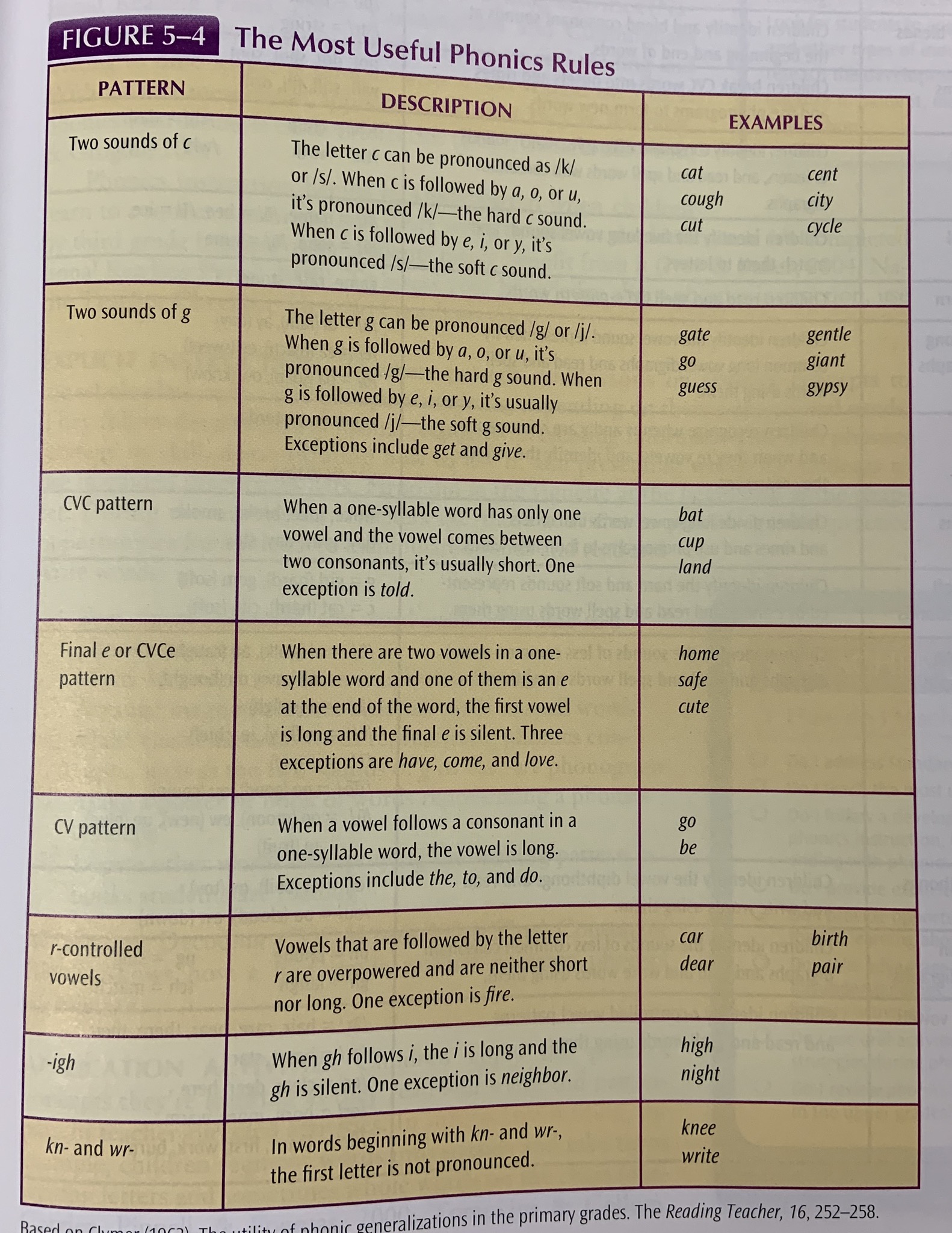
Graphonemic: the recognition of letters and the understanding of sound-symbol. relationships and spelling patterns; its often referred to as phonics.
Phonemic Awareness: the parts of sound in a word.
Phonics: anything in writing.
Consonant Digraph: two consonants make a combination, representing single sounds that aren’t represented by either letter. the letters some together to create a unique sounds such as /ch/, /sh/, or /st/.
Dipthong (vowel digraphs): two vowels represent a glide from one sound to another, like oi or oy.
R-controlled (bossy R) vowels: when one or more vowels are followed by an R, the R influences the pronunciation of the vowel sound.
Onset: the consonant sound (if any) the precedes the vowel. Ex. Sh [ow]
Rime: is the vowel and any consonant sounds that follows the onset. Ex. [sh] ow
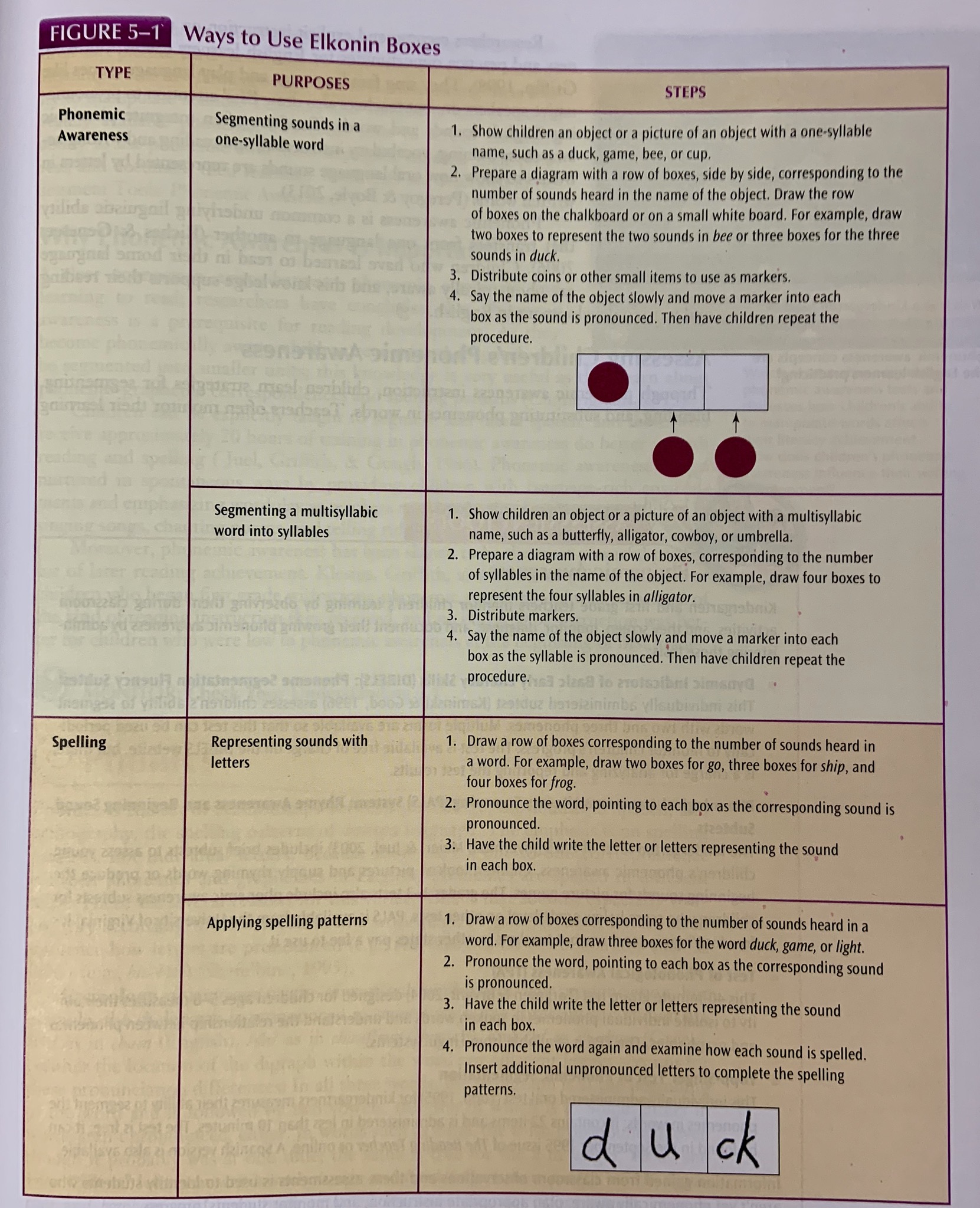
Elkonin Boxes: the teacher shows an object or a pictures of an object and draws a row of boxes, with one box for each phoneme in the name of the object or picture. then the teacher or a child moves a marker into each box as the sound is pronounced. this is not for syllables, this is for sounds. For example: BEE would only need to boxes for /B/ and /ee/. Below is an example of how we use Elkonin Boxes
Teaching Phonics
The best way to teach phonics is through a combination of explicit instruction and authentic application activities. The most useful phonics skills are taught in a predetermined sequence. Most teachers begin with consonants and then introduce the short vowels so that children can read and spell consonant-vowel-consonant (CVC) words, such as dig or cup. The learning continues in a scaffold, the image below shows all the steps after CVC words.
Phonemic Awareness Strategies
the image below states phonemic awareness strategies
Teaching Phonemic Awareness
Teachers nurture children’s phonemic awareness through the language-rich environments they create in their classroom. They sing songs, chant rhymes, read aloud wordplay books, and play games; children have many oppurtunities to orally match, isolate, blend, and subsititute sounds and to segment words into sounds.
Phonemic awareness instruction should meet three criteria:
The activities should be appropriate 5- and 6-year old. Activities involving songs rhymes, riddles, and wordplay books are good choices because they encourage children’s playful experimentation with oral language.
The instruction should be planned and purposeful, not just incidental. Teachers need to choose instructional materials and plan activities that focus on the children’s attention on the sound structure of oral language.
Phonemic Awareness activities should be integrated with other components of a balanced literacy program. It’s crucial that children percieve the connection between oral and written language.
Here is a list of book that are helpful with phonemic awareness activities and instruction.
Teaching Spelling
One of the best ways to teach spelling is through weekly spelling tests but, tests should never be considered a complete spelling program. To become good spellers, children need to learn about the English orthographic system and move through the stages of spelling development. They develop strategies to use in spelling unknown words and gain experience is using dictionaries and other resources. A complete spelling program includes:
teaching spelling strategies
matching instruction to students’ stage of spelling development
providing daily reading and writing opportunities
teaching students to spell high-frequency words
Important spellings strategies include:
segmenting the word and spelling each sound, often called “sound it out”
spelling unknown words by analogy to familiar words
applying affixes to root words
proofreading to locate spelling errors in a rough draft
locating the spelling of unfamiliar words in a dictionary
Classroom Application
One of the biggest things this I can take away from this chapter is the book list it gives, to help with phonemic awareness. I plan to save all the given book lists and tentatively plan to use them in the classroom. This is a great resource that is just given and you don’t need to search for.
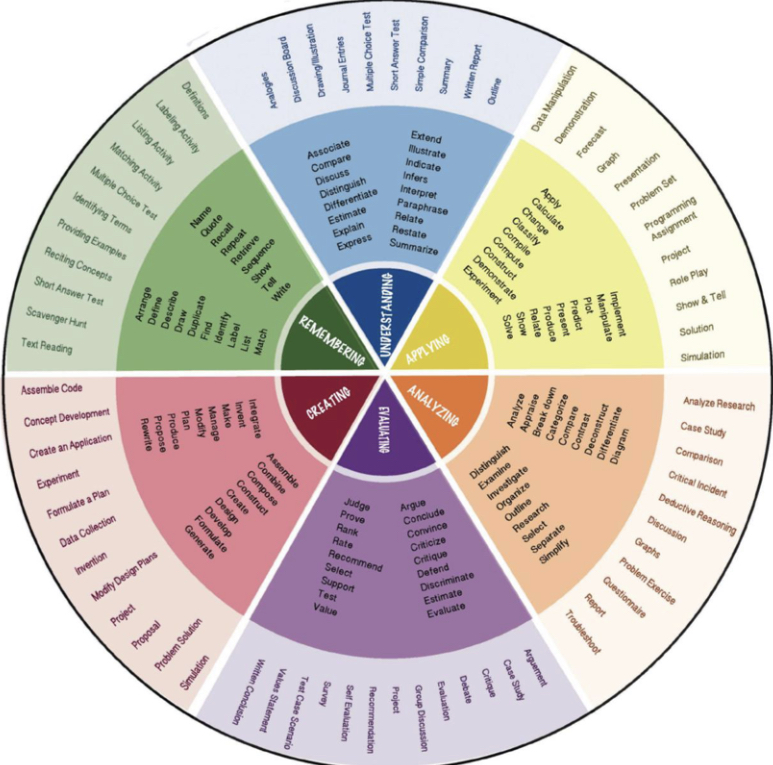
learning objectives are general statements of desired learning. They are specific statements. Learning objectives are also student-centered and are specific learning targets for students. They describe outcomes – NOT activities. They should state what is to be accomplished by students at the end of a lesson and the outcome should be appropriately challenging. These are written in a specific and purposeful way that guides teacher lesson planning and communicates daily student learning outcomes.
The acronym “S.M.A.R.T.” is used to make sure learning objectives are: Specific, Measurable, Attainable, Relevant/Results-oriented, and Time-bound. SMART learning objectives use Bloom’s Taxonomy of learning domains. Attached below is a picture of the “modern” version of Bloom’s Taxonomy. The words connected to the Taxonomy are essential as the verbs of SMART learning objectives.
There are also verbs you should not use called “Weasel Words”. These words are not measurable or specific. They include verbs like: learn, see, imagine, understand, appreciate. etc.
Non-example of a student-centered learning objective:
Students will hear a lecture on graphing linear equations.
Correct example of a student-centered learning objective:
After observing a lecture with examples, students will graph linear equations.
These examples differ because the non-example is stating what the students will be doing. The correct example states what the students will be able to do after.
Chapter Four
Concepts About Print
Through experiences in their homes and communicates, young children learn that print carries meaning and that reading and writing are used for a variety of purposes. They learn meaning by noticing things such as menus or receiving/writing letters. Children’s understanding about the purposes of reading and writing reflects how written language is used in their community. This varies from community to community because they vary the way they use language.
Concepts About Words
At first, young children only have vague notions of literacy terms such as: word, letter, sound, and sentence but, they develop an increasingly sophisticated understanding of these terms. There is four levels to this. the first level is having a vague notation and don’t differentiation between words and things. The second level is when they can describe words as labels for things. children consider words that stand for objects as words but, thy don’t classify articles and prepositions as words because words such as: the and with, because they can’t be represented by objects. The third stage level is when children can understand that words carry meaning and stories are built from words. The last level is when more fluent readers can describe words as autonomous elements, having meaning of their own with definite semantic and syntactic relationships.
Concepts about the Alphabet
Young children also develop concepts about the alphabet and how letters are used to represent phonemes. Components of letter knowledge include:
Letter names
Formations of letter in upper and lowercase manuscript handwriting
features of letter that distinguish it from other letters
directions the letter must be turned to distinguish it from other letters
use of the letter in known words
sound the letter represents in isolation
the sound the letter represents in combination with others
the sound the letter represents in the context of a word
Children use this knowledge as the read to decode unfamiliar words as they read and to create spellings for words as they write. Inserted below is a list of routines for teaching the alphabet.
Assessing Concepts of Written Language
Teachers regularly observe children as they look at books and reread familiar ones to monitor their developing knowledge about written language concepts. They notice which concepts children understand and which ones they need to continue to talk about and demonstrate during shared reading.
Shared Reading: Teachers read aloud books and other texts that students could not read independently. Often teachers use big books so that all students can see the text and read along. This differs from reading aloud because students can see the text as the teacher reads. Students will often join in the reading aloud of repeated phrases or rhymes.
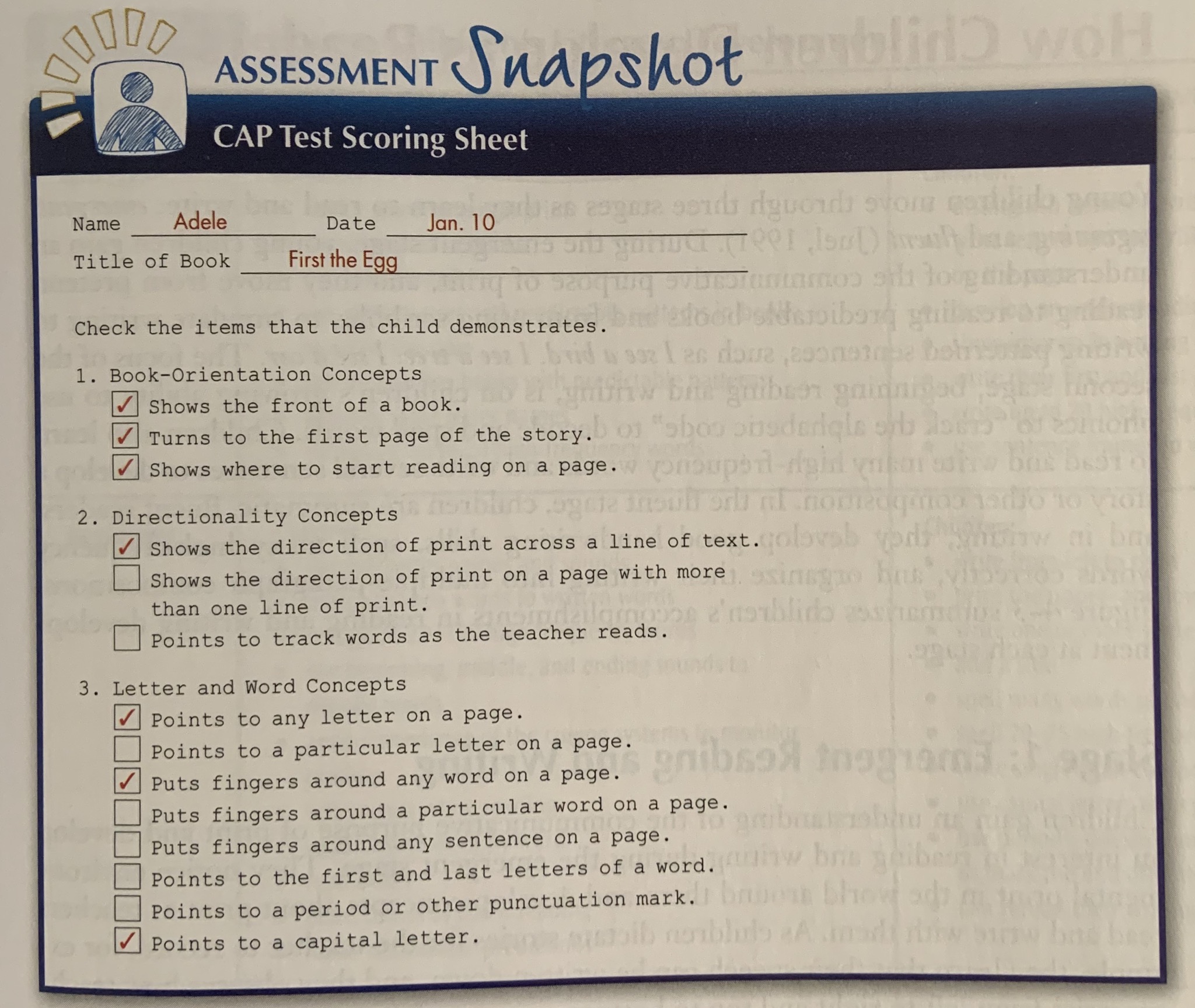
Teachers use the Marie Clay’s Concepts About Print (CAP) test and create their own versions of the test to assess young children’s understanding of written language concepts. Below is an example of a CAP test:
Language Experience Approach (LEA)
LEA is based on children’s language and experiences. In this approach teachers use shared writing: students dictate words and sentences about their experiences and the teacher writes down what the students say; the text they develop become the reading material. Because the language comes from the children themselves and because the content is based in their experiences, they’re usually able to read the text easily.
Emergent, Beginning, and Fluent Reading and Writing Levels
The image below describes what each stage looks like for both reading and writing.
Morning Message
A daily literacy routine that teachers use to teach literacy concepts, strategies, and skills. The teacher writes a brief message on chart paper, usually in the form of a friendly letter, about what will happen that day; then the message is read at the beginning pf the school day. Afterward, children reread it and count the letters, words, and sentences in the message. Depending on their level of literacy development, they also pick out familiar letters and words, words following a particular phonics patter, high-frequency words, or capital letters, and punctuation marks. A couple types of morning messages are a fill-in-the-blank morning message, where teachers read the letter with the blank spaces and during the second reading, children identify the missing words. Another type is when one student dictates a message to share with the class, where the children take turns dictating a message to share with classmates. The last type is when the children collaboratively create the morning message. This is done at the end of the day and the teacher and students discuss what they did that day and, what to write in their letter.
Vocabulary for Chapter Four
Environmental print: Young children begin reading by recognizing logos on fast food restaurants, department stores, grocery stores, and commonly used household items within familiar contexts. They recognize the golden arches of McDonald’s and say “McDonald’s!” but, when they are shown the word McDonald’s written down without the familiar sign, they can’t read it.
Revising Groups: Children share their rough drafts of writing in groups of four of five. Sometimes teachers join in but, usually students run the group themselves. They take turns reading their rough drafts to each other and listen as their classmates offer complements and suggestions for revision.
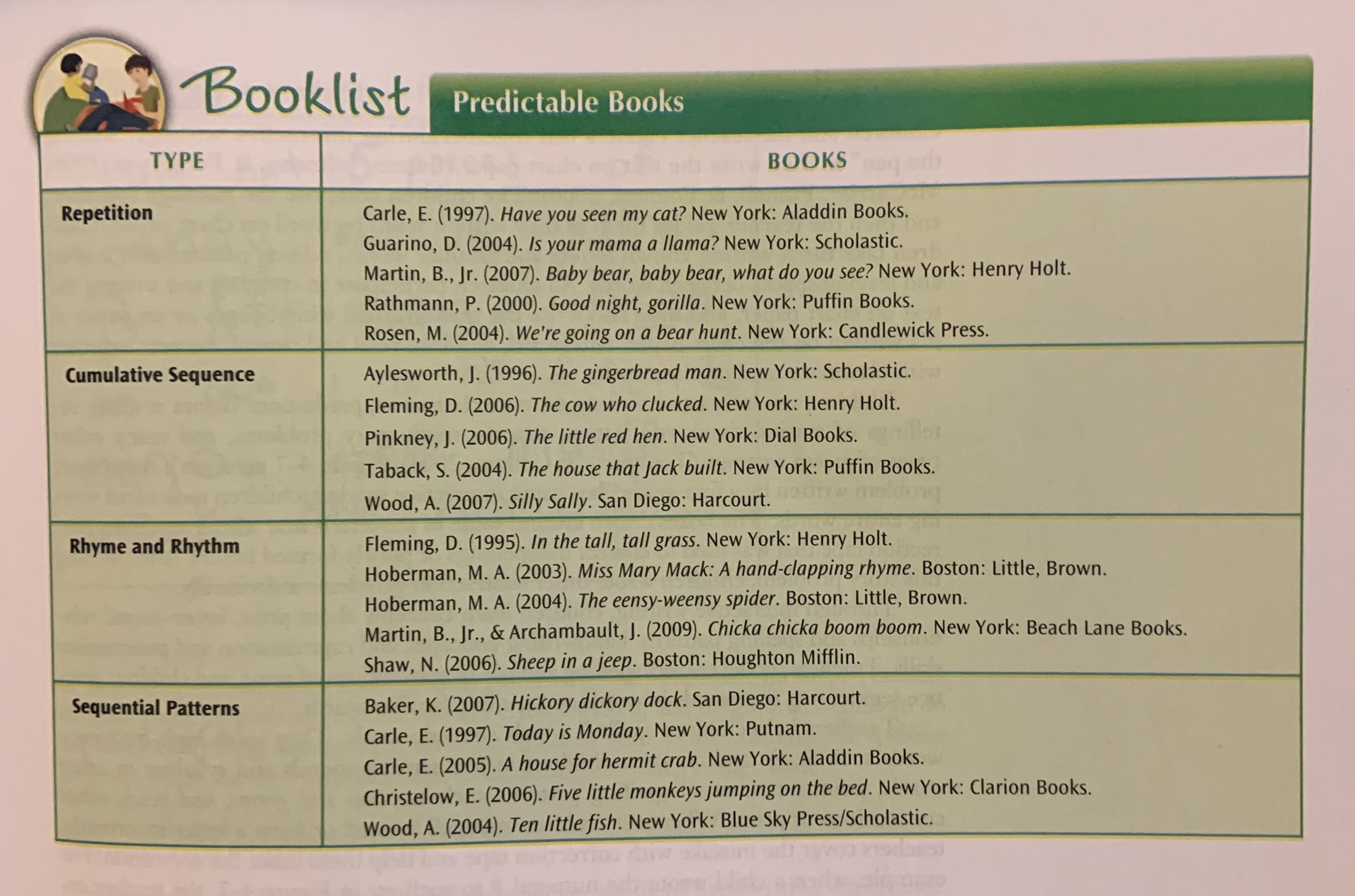
Predictable Books: Books that often have repeated sentences, rhyme, or other patters. Teachers use these for shared reading. There are four common types of predictable books, and they are listed below, along with books that use each one.
Vocabulary Cont.
Interactive Writing: Children collaboratively create a message together and the teacher guides them as they write it word for word (taking turns) on chart paper.
Manuscript Writing: In kindergarten this focuses on developing children’s ability to hold pencils, refining their fine motor control, and focusing on letter formation. After they learn this, they focus on refining and perfecting their handwriting. Manuscript essentially means handwriting.
Interactive Reading: teachers model comprehension skills by reading and thinking out loud for their students. Engaged readers then use the same interactive skills their teachers have demonstrated to comprehend their own texts.
Choral Reading: Students take turns reading lines of a poem or story. The students support one another by actively participating and sharing the work.
Guided Reading: Students work in small groups with others who read at the same level. They do the reading themselves but, sometimes teachers will read the first few pages to help them get started. Guided reading sessions last about 25-30 minutes and teachers observe each individual student as they read. Teachers then use their observations to choose mini lessons and other books for students to read.
Word wall: Students and teachers add important words to a “word wall”. Students can then reference these words while doing word-related activities.
Mini lessons: As teachers teach lessons about strategies and skills, they provide practice activities ans supervise as students apply what they’re learning.
Interactive Read-Aloud: An activity where students engage in listening and talking about/discussing the text throughout a read-aloud, instead of before and/or after. The teacher may read aloud a page or, a few pages, and stop to discuss key ideas, illustrations, or other text features that will aid comprehension, make connections to other texts, and/or confirm/dis-confirm prior predictions.
Classroom Application
I really enjoyed the idea of a morning message. These two morning message ideas stood out to me: collaborative morning messages and morning messages dictated by an individual student. A collaborative message would give the children a great chance to discuss and create something as a group. A Message created by an individually student would give them a chance to be in the spotlight and showcase their own work. Both of these are great morning message ideas and I want to use both of these in my future classroom.
Teachers plan for assessment while planning for instruction. They think about questions while doing so, a few of these questions include:
Are students struggling?
Are students completing assignments?
DO students have adequate background knowledge?
Have students learned the concepts that have been taught?
By planning for the assessment before they begin teaching, teachers are prepared to use assessment tools wisely.
Step Two: Monitoring Students’ Progress
Teachers monitor students’ learning everyday and use the results to make instructional decisions. As they monitor students’ progress through observations, conferences, and other informal, formative procedures, teachers learn about students and their individual strengths.
Observations: effective teachers are “kid watchers”, a term used to describe “direct and informal observation of students”. To effectively observe, teachers must focus on what students do as they read of write, not focused on behavior. Observations should be planned and teachers usually observe certain students or groups on certain days so, throughout the week all students are observed.
Anecdotal Notes: These are brief notes that teachers write down as they observe students. They usually describe specific events and report observations, rather than evaluating observations.
Conferences: Teachers talk with students to monitor their progress as well as to set goals and help them solve problems. There are multiple ways to do this and they include: On-the-spot Conferences, Planning conferences, revising conferences, book discussion conferences, editing conferences, and evaluating conferences.
Checklists: Checklists simplify assessment and enhance students learning. Teachers identify the evaluation criteria in advance so students understand what is expected of them before they begin working.
Step Three: Evaluating Students’ Learning
Teachers document students’ learning to make judgement about their achievement. At this stage the assessment is usually summative. Tests are a traditional way to evaluate students’ learning but, teachers prefer to evaluate students’ actual reading and writing to make judgments about their achievement.
Rubrics: A set of guidelines and expectations for a specific project or assignment that assess the students work, these usually rank performance by numbers 1-5.
Step Four: Reflecting on Students Learning
Teachers reflect on their instruction to improve their teaching effectiveness. They ask themselves questions about lessons that were successful and those that weren’t and how they might adapt instruction to meet their students’ needs.
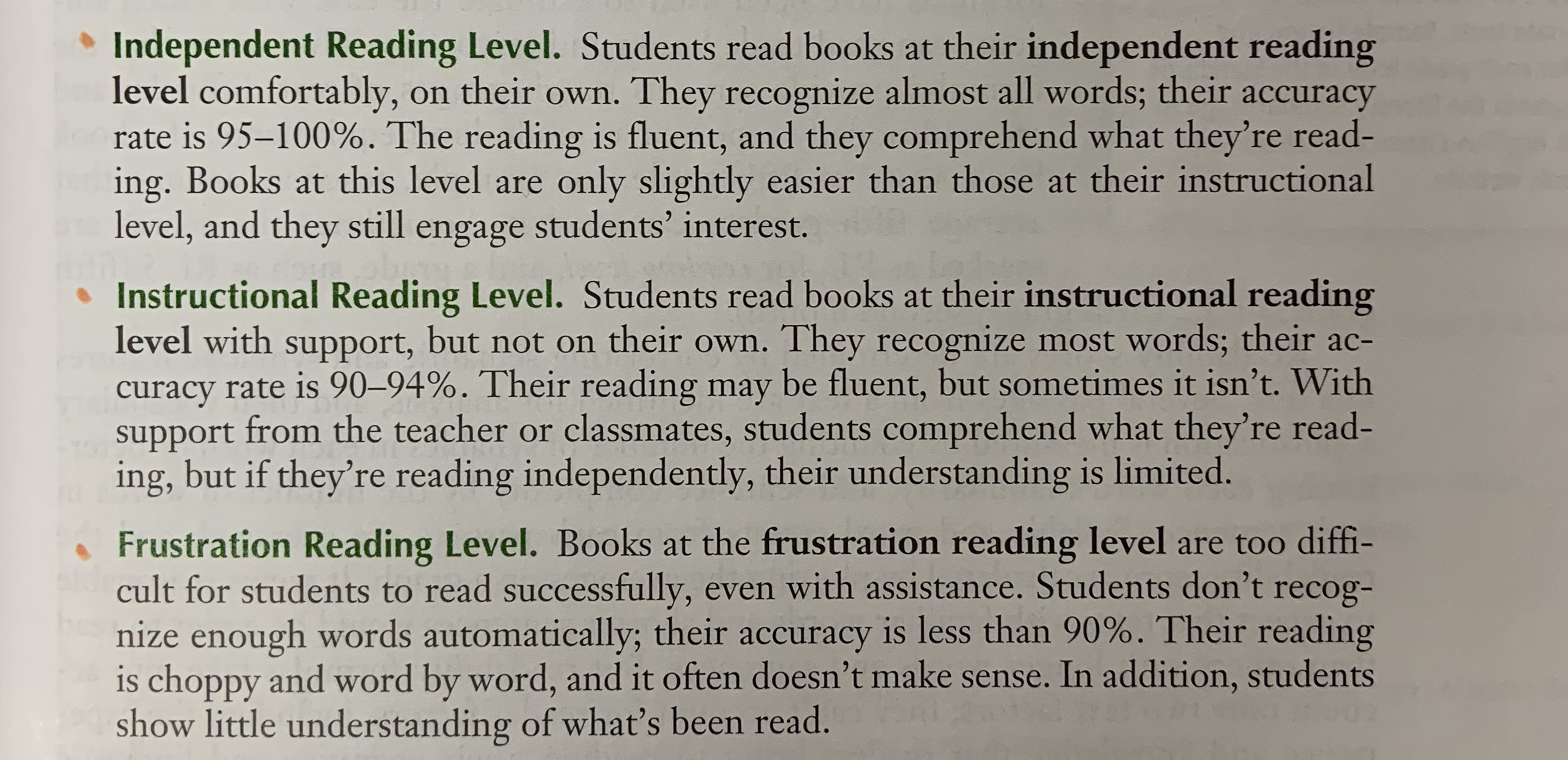
Three Reading Levels
Listed below are the three reading levels, along with a description.
SOLOM: An assessment tool many teachers use is the Student Oral Language Observation Matrix (SOLOM). This is a rating scale that teachers use to assess students’ command of English as they observe them talking and listening. It addresses the five components of oral language: Listening, fluency, vocabulary, pronunciation, and grammar.
Vocabulary for Chapter Three
Running Records: A continuous record of a students oral reading to help identify errors made.
Mini lessons: As teachers teach lessons about strategies and skills, they provide practice activities throughout the lesson and supervise as students apply what they’re learning.
Book Talk: Students give book talks to their classmates. It is a presentation of the book where students share the book information, summarize, try to interest classmates to read that book.
Portfolio: A portfolio is a collection of student work. Students and teachers use portfolios to evaluate the student and showcase their best work. Portfolios are systematic and meaningful collections of artifacts that document students’ literacy development and growth.
Portfolio Assessment: In the process of making the portfolio, students learn to establish criteria for their selections. They also help teachers see patterns of growth and are used in parent-teacher conferences to supplement the information on the report card.
Guided Reading: Students work in small groups with others who read at the same level. They do the reading themselves but, sometimes teachers will read the first few pages to help them get started. Guided reading sessions last about 25-30 minutes and teachers observe each individual student as they read. Teachers then use their observations to choose mini lessons and other books for students to read.
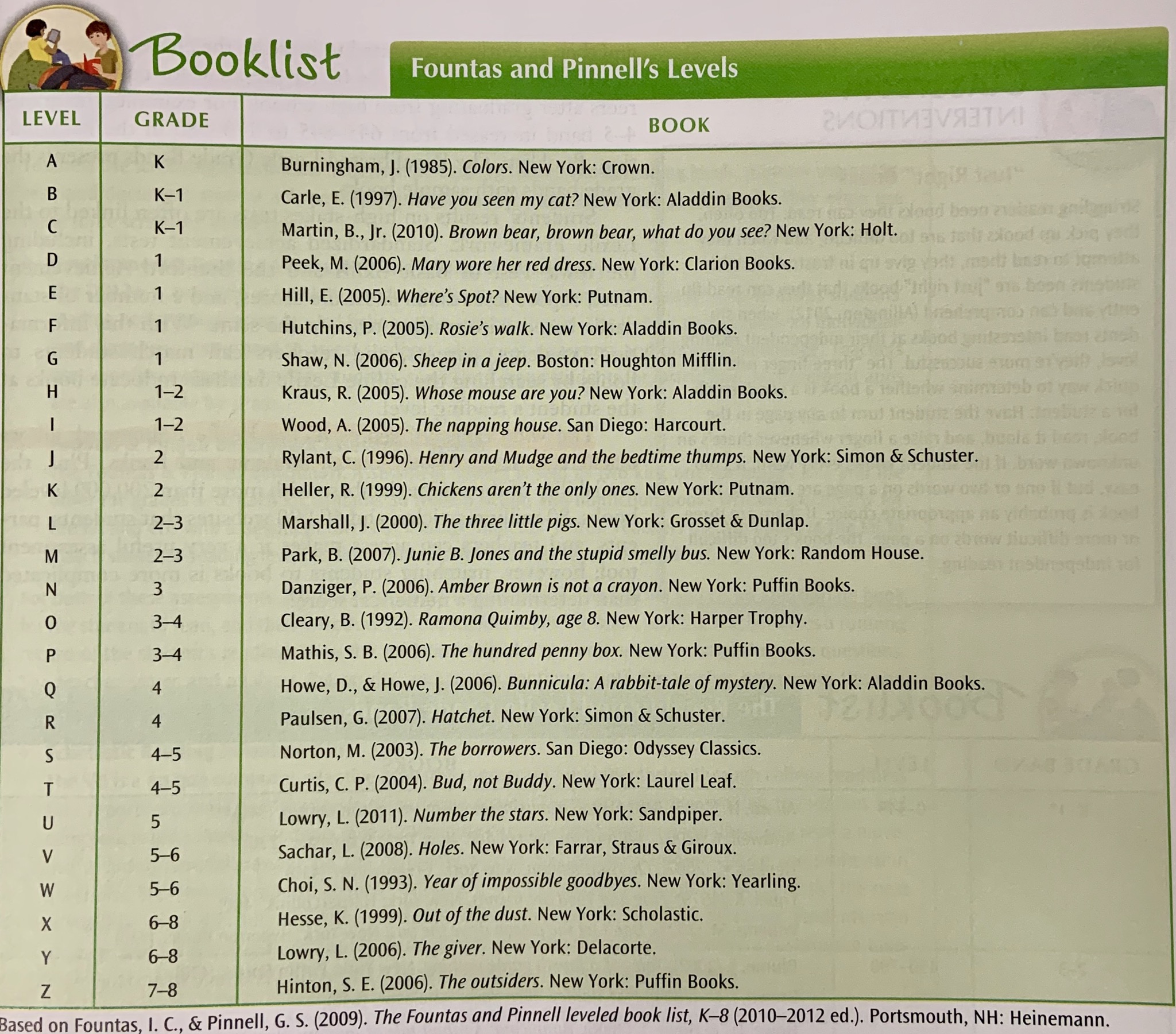
Leveled Books: To match students to books in grades K-8, Fountas and Pinnell (2006) developed a text gradient, or classification system that arranges books along a 26 level continuum (A-Z) from easiest to hardest. Below is an image of a list of leveled books
Vocabulary Cont.
Lexile Framework: This is a method of standardized testing that is used to measure both students’ reading levels and the difficulty level of books. Word familiarity and sentence complexity are two of the factors used to determine the difficulty level of books. Lexile scores range from 100-1300. These scores also coordinate with the Common Core Standards.
Informal Reading Inventories (IRIs): these are commercial tests to evaluate students reading performance and are used from first to eighth grade but, are not as helpful in younger grades. These are often used a screening instrument to determine whether students are reading at grade level. They also serve as a diagnostic tool, helping to identify students who are struggling.
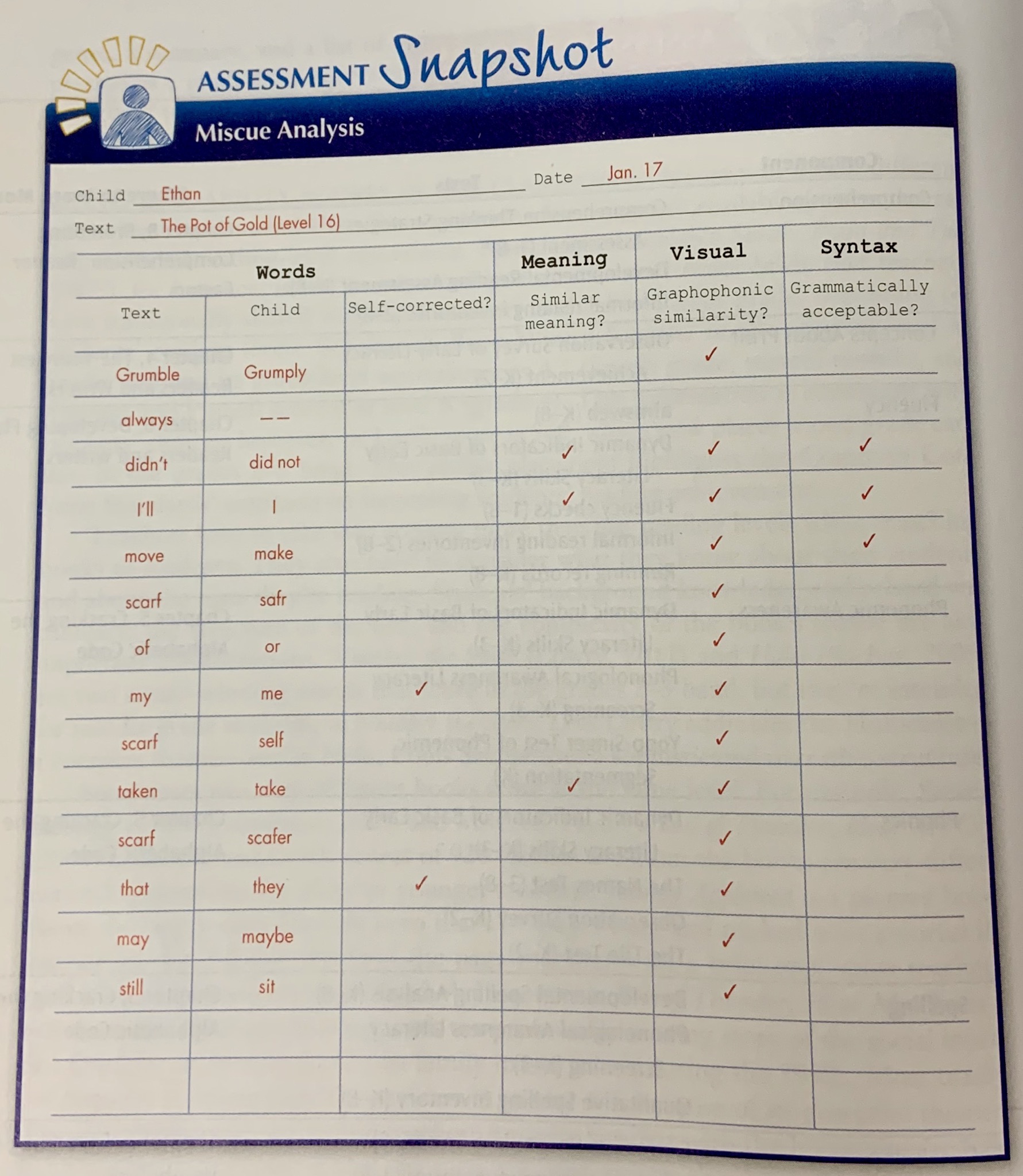
Miscue Analysis: A miscue is a mistake made while reading aloud. A Miscue analysis is a procedure for categorizing and analyzing a students oral reading errors. The image below is an example of a miscue analysis.
KWL Charts: A KWL chart stands for “Know” “Want to Know” and “What you learned” and it is a worksheet that students fill out before, during, and after a lesson. They also recently added another category at the end of this called “Want to learn”. It is a good way to bridge background knowledge with content.
High-Stakes Testing: These are tests that are designed to objectively measure students knowledge according to grade-level standards. These tests usually have consequences for poor performance and this creates an anxiousness and nervousness. Students tend to feel a lot of pressure when taking a high stakes test. These scores provide little information for day-to-day instructional decisions but, students, teachers, and administration are help accountable by the results.
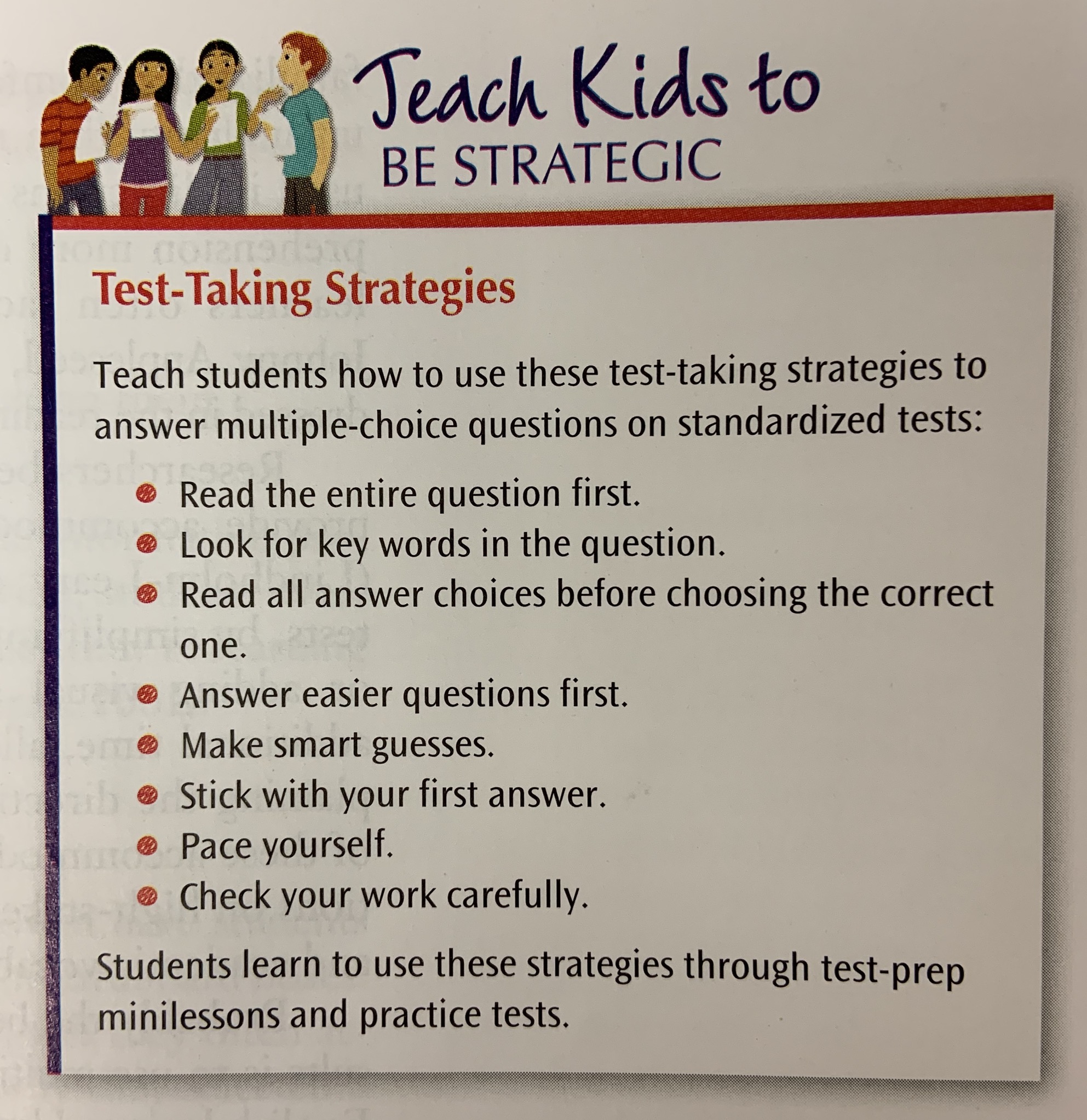
Test-taking strategies
Lesson Plans
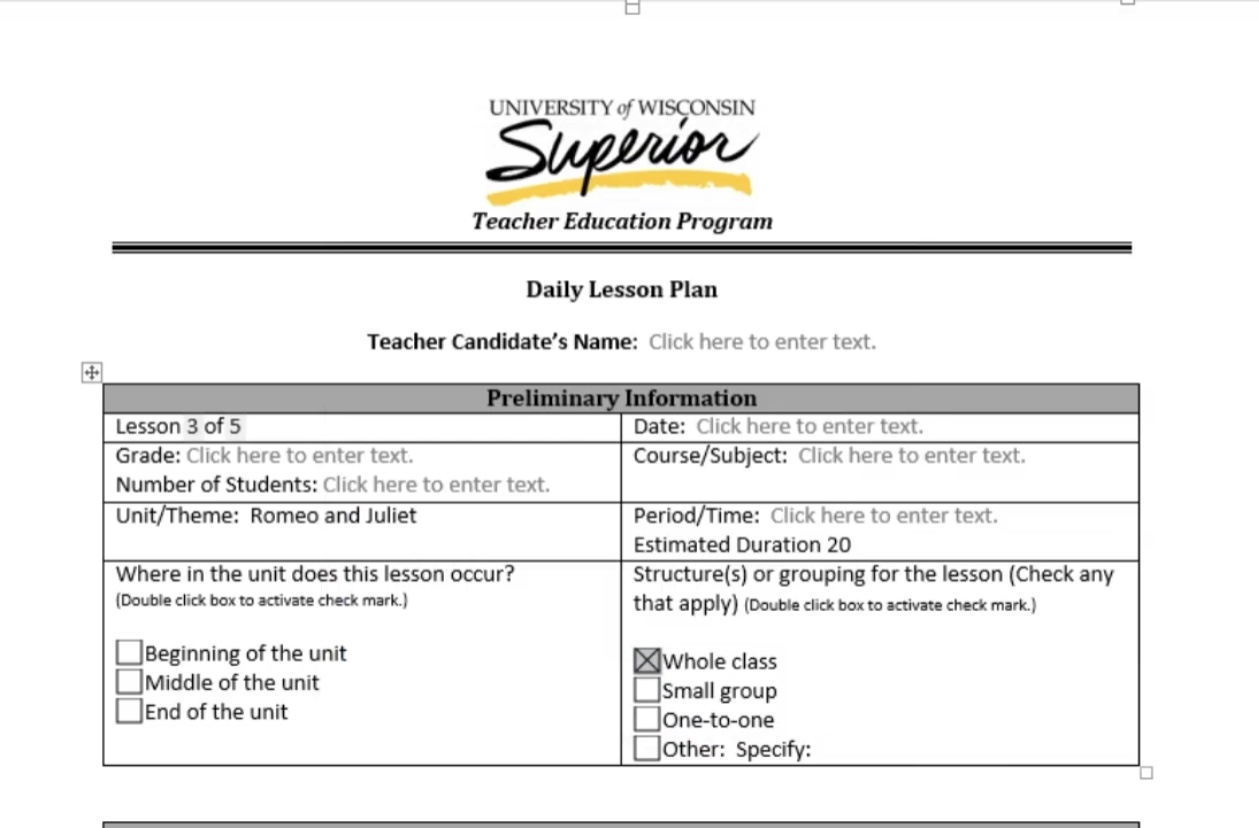
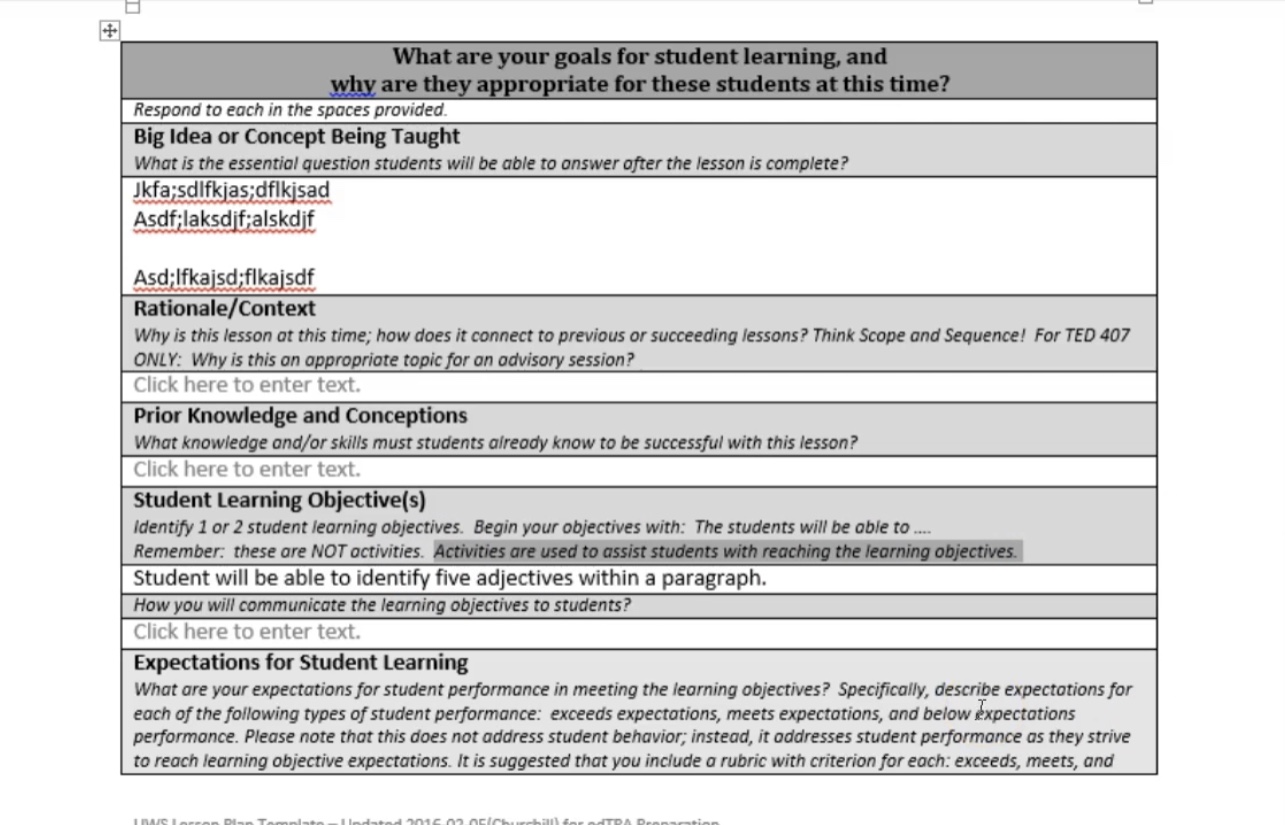
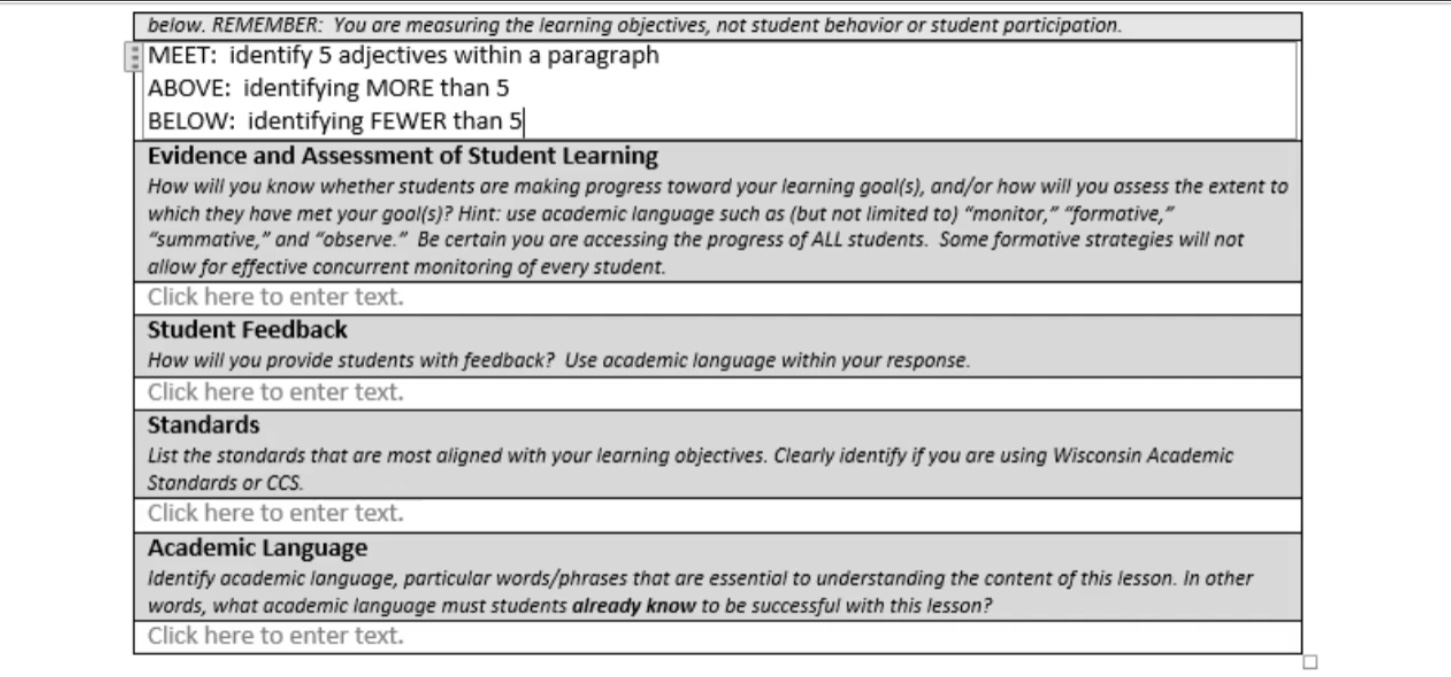
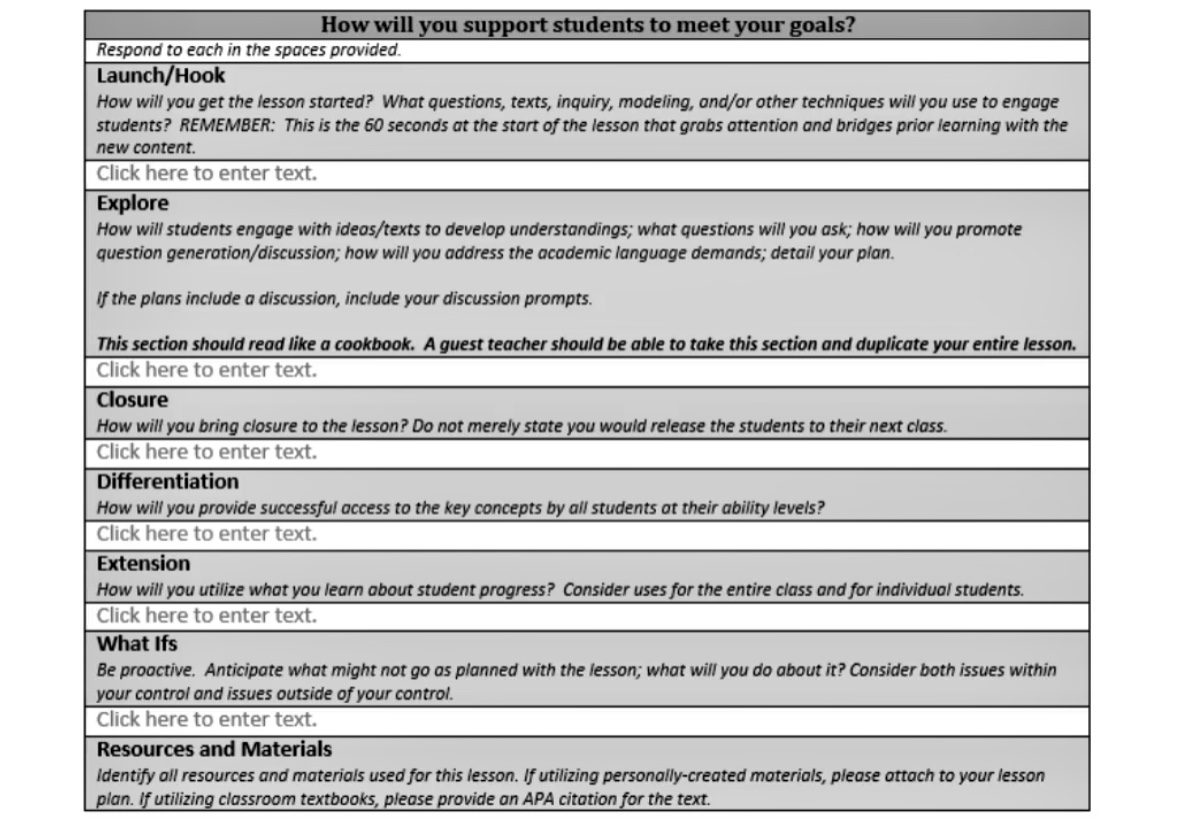
At UWS, most of the education department professors require students to use the lesson plan template. This template has four sections, covering the different aspects of creating a lesson.
This is the first section. This section includes aspects like where the lesson is throughout the subject, the lesson duration, and the theme.
This is the second section. This is the goals of the lesson, what the lesson is, and the explanation of why you chose this lesson. This is the third section. This section is not measuring behavior but, is just measuring objectives. This section includes your choice of assessment and the feedback (not grades, just feedback) you will give. Academic language is essentially academic background knowledge.
This is the fourth and last section. It includes the hook, explore, closure, differentiation, extension, and what-ifs. The hook grabs their attention, explore is the sense making activities you will do and it should be able to be followed (like a cookbook) by other teachers, and the extension is what you will do with the students after the lesson, depending on the knowledge gained. The what-ifs are situations that could happen during your lesson, both in and out of your control.
Classroom Application
As future teachers, we always want to be observant and continuously evaluating our students. This is something I will strive for in my class but, it also comes naturally. I tend to watch people, their mannerisms, body language, tone, etc. I notice patterns in people and also noticed when those patterns as disturbed. This skill will really benefit me while attempting to implement observations of 20+ students. I also figured out that I tend to use anecdotal notes myself already. I’m somewhat forgetful so, I try to write things down as soon as they happen. This will make taking anecdotal notes in class almost like habit.
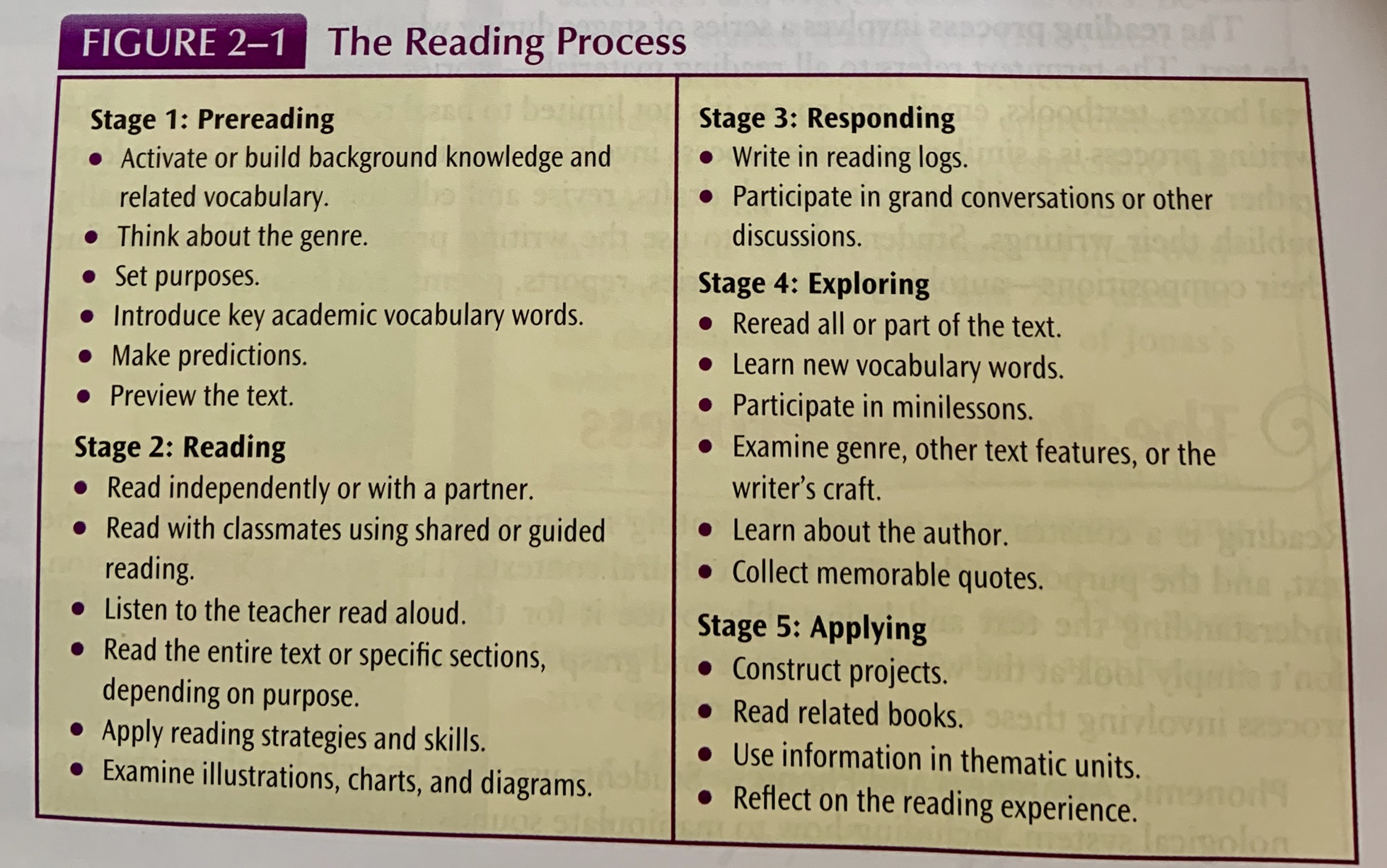
The reading process has five stages. It is always used, no matter what instructional process a teacher chooses. Although, the activities teachers use for each stage may vary, they all teach using the writing process. Figure 2-1 states all five stages and what happens in each stage.
Vocabulary involving the reading process
Phonemic Awareness: The understanding and ability to identify the smallest unit of sound in a word.
Phonics: Writing. Anything in written words in considered phonics.
Word Identification: Students recognize high frequency words automatically and use their knowledge of phonics and word parts to decode unfamiliar words.
Fluency: The ability to recognize most words automatically, to then be able to read quickly with expression. Fluent readers devote most of their cognitive resources, instead of focusing on identifying the words their reading.
Vocabulary: Students chose appropriate meaning, recognize figurative uses, and relate them to their background knowledge. Knowing the meaning of words influences comprehension.
Comprehension: Students use a combination of reader and text factors to understand what they’re reading. TO create meaning they predict, connect, monitor, repair, and use other comprehension strategies.
Students use phonemic awareness and phonics to be able to learn word identification, fluency, vocabulary, comprehension. There are the basis of all reading and writing skills.
Vocabulary Continued
Background knowledge: There are two types of background knowledge: general and specific.
General background knowledge: world knowledge, this is what students have acquired through their life experiences and learning in their home communities and at school.
Specific background knowledge: literary knowledge, this is what students need to read and comprehend text. This is includes information about reading, genres, and text structures.
Mini lessons: As teachers teach lessons about strategies and skills, they provide practice activities ans supervise as students apply what they’re learning.
Guided reading: Students work in small groups who read at the same level. They do the reading themselves but, sometimes teachers will read the first few pages to help them get started. Guided reading sessions last about 25-30 minutes and teachers observe each individual student as they read. Teachers then use their observations to choose mini lessons and other books for students to read.
Shared reading: Teachers read aloud books and other texts that students could not read independently. Often teachers use big books so that all students can see the text and read along. This differs from reading aloud because students can see the text as the teacher reads. Students will often join in the reading aloud of repeated phrases or rhymes.
Interactive read-aloud: Teachers read aloud books that are developmentally appropriate but, are above reading level. As teachers read, they engage students in activities instead of waiting until after.
Word wall: Students and teachers add important words to a “word wall”. Students can then reference these words while doing word-related activities.
Word sort: Students use word sorts to explore, compare, and contrast word features. Teachers prepare word cards for students to sort into two or more categories according to their spelling patterns or other criteria.
Readers Theatre: students assume roles from a play and read their lines from a script. These are usually introduced, practiced, and then preformed.
The Writing Process
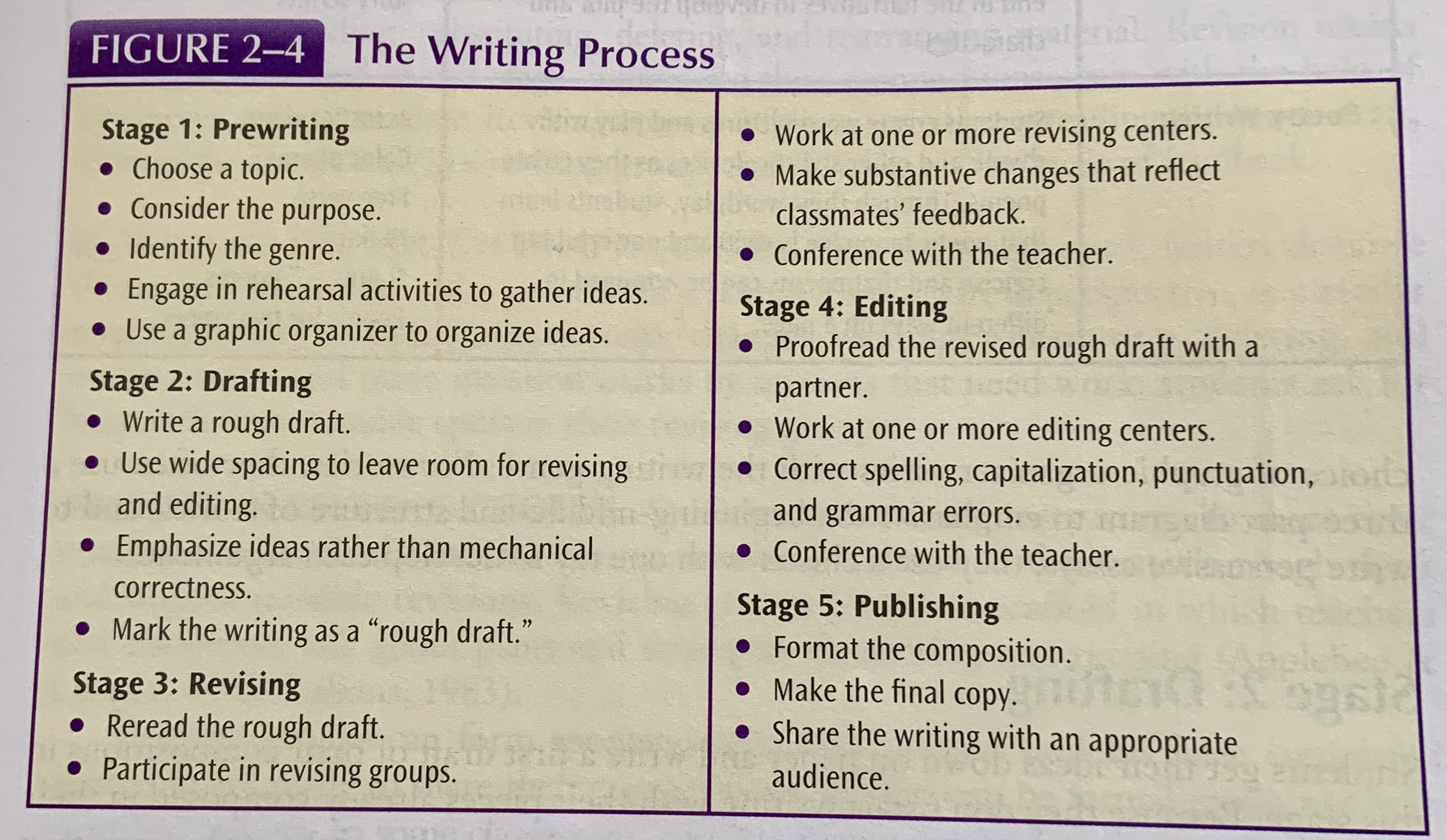
The writing process involves five stages. Although these stages are numbered 1-5, it is not a linear process. It usually involves recurring cycles. Students often merge and/or reoccur stages as they write. Figure 2-4 states all stages of the writing process and what happens in each stage.
Reading Strategies
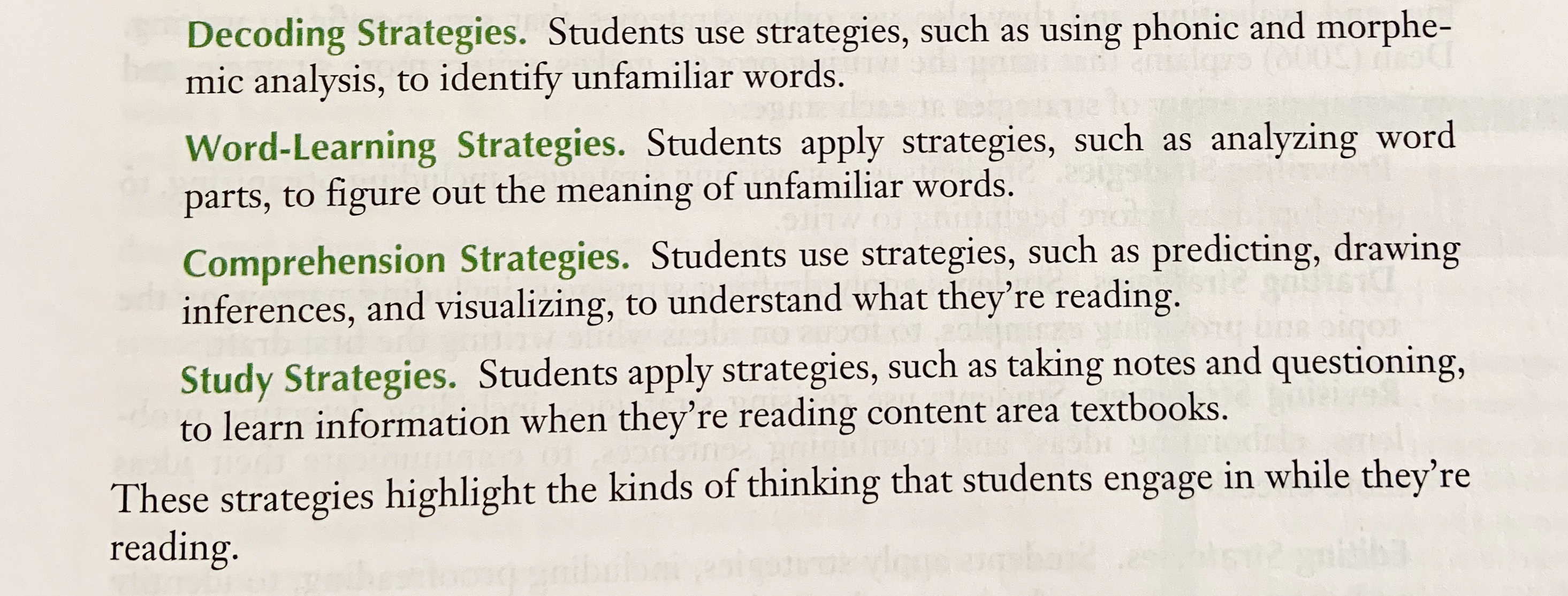
Comprehension strategies are the best known type of reading strategies, but students use strategies throughput the reading process. The image below states four types of strategies and what they entail.
Writing Strategies
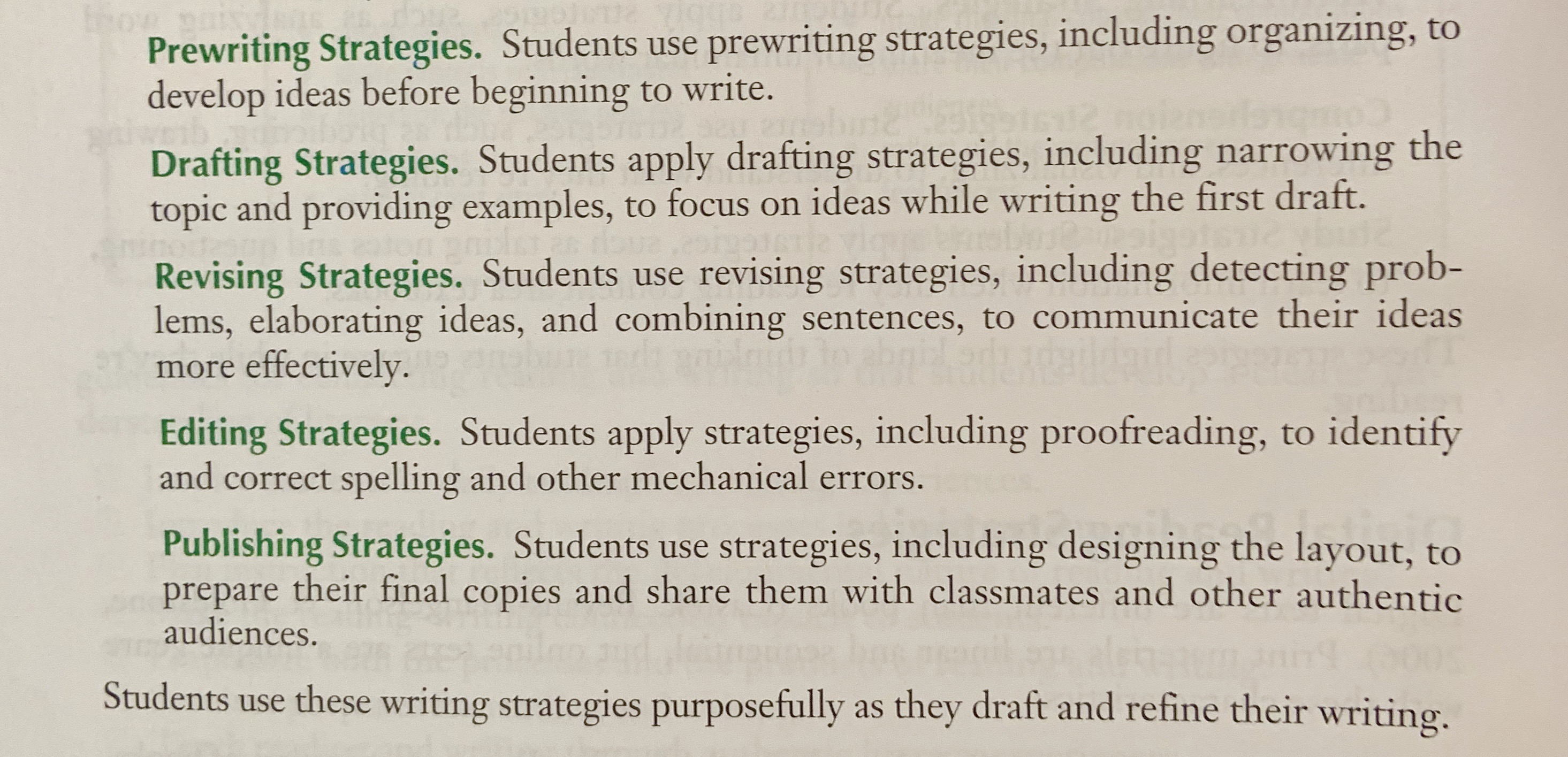
Writing strategies are tools students use deliberately to craft effective compositions. These are similar to reading strategies because they both activate background knowledge, question, repair, and evaluate and use other strategies specific to writing. The image below states five strategies and what they entail.
Classroom application
All of the aspects in this chapter will be implemented in my classroom. Reading and writing are two of the larges areas of content, especially in primary school. Reading activities usually involve writing. For example, when you read a passage most of the time there is some sort of written reflection of the text, or questions to answer afterwards. This also works the other way, writing activates usually involve reading. This can even be as simple as a student reading something they had just written.
The Common Core Standards Initiative has identified the knowledge students are expected to learn at each grade level (K-12). These standards are to be followed and students are expected to meet these standards. The standards are separated into five strands: writing, speaking and listening, language, and media and technology. However, they state what the student needs to know, it does not state how. This gives teachers the freedom and creativity to execute these standards however they see fit.
Principal 6: Effective Teachers Scaffold Students’ Reading and Writing
Teachers scaffold students’ reading and writing as they demonstrate, model, guide, and teach, and thy vary the amount of support they provide according to the instructional purpose and students’ needs. Teachers use five levels of support, moving from more to less as students assume responsibility. These five levels are: modeled, shared, interactive, guided, and independent.
Vocabulary for Principal 6:
Scaffolding: Teachers provide varying levels of support so that all students can be successful. They use a combination of the five levels of scaffolding.
Shared Reading: The teacher will chose a book and read it aloud to the class. The teacher does most of the reading aloud, but children join in to read familiar an predictable words are phrases. These phrases usually rhyme or are repetitive.
Choral Reading: Students take turns reading lines of a poem or story. The students support one another by actively participating and sharing the work.
Readers Theatre: Students assume roles from a play and read their lines from a script. These are usually introduced, practiced, and then preformed.
Interactive Writing: Students and the teacher create a text and write a message. The text is composed by the group, and the teacher assists as the students take turns writing the words of the text.
Minilessons: As teachers teach lessons about strategies and skills, they provide practice activities ans supervise as students apply what they’re learning.
Principal 7: Effective Teachers Organize for Instruction
No single instructional program best represents the balanced approach to literacy; instead, teachers organize for instruction by creating their own program that fits their students’ needs and their school’s standards and curriculum guidelines. Instructional programs should reflect these three principals: Teachers create a community of learners in their classroom, Teachers incorporate the components of the balanced approach, and Teachers scaffold students’ reading and writing experiences. In this figure, there are the popular instructional programs.
Vocabulary for Principal 7:
Instructional Programs: Programs and activities teachers use to ensure and help their students reach their standard goals.
Nurturing English Learners: English learners benefit from participating in the same instructional programs that mainstream students do, and teachers create classroom learning contexts that respect minority students and meet their needs.
Principal 8: Effective Teachers Differentiate Instruction
Effective teachers adjust their instruction because their students vary in their levels of development, academic achievement, and ability. This does not mean the instruction changes, but it may be tweaked for certain students to fit their needs. One-size-fits-all techniques are non-beneficial and teachers respect students by honoring both their similarities and their differences.
Vocabulary for Principal 8:
Differentiation: Making changes or tweaks to a lesson plan or instructional approach to challenge and benefit all students.
Principal 9: Effective Teachers Link Instruction and Assessment
Assessment is seen in test taking, but is also a daily part of classroom life. Teachers collect and analyze data from observations, conferences, and classroom tests, and they use the results to make decisions about students’ academic achievement and plan interventions.
Vocabulary for Principal 9:
Assessment: An integral and ongoing part of both learning and teachers, and a way to assess the student to see where they are, where they excel, and where they fall behind.
Running Records: A record of a students oral reading to help identify errors made.
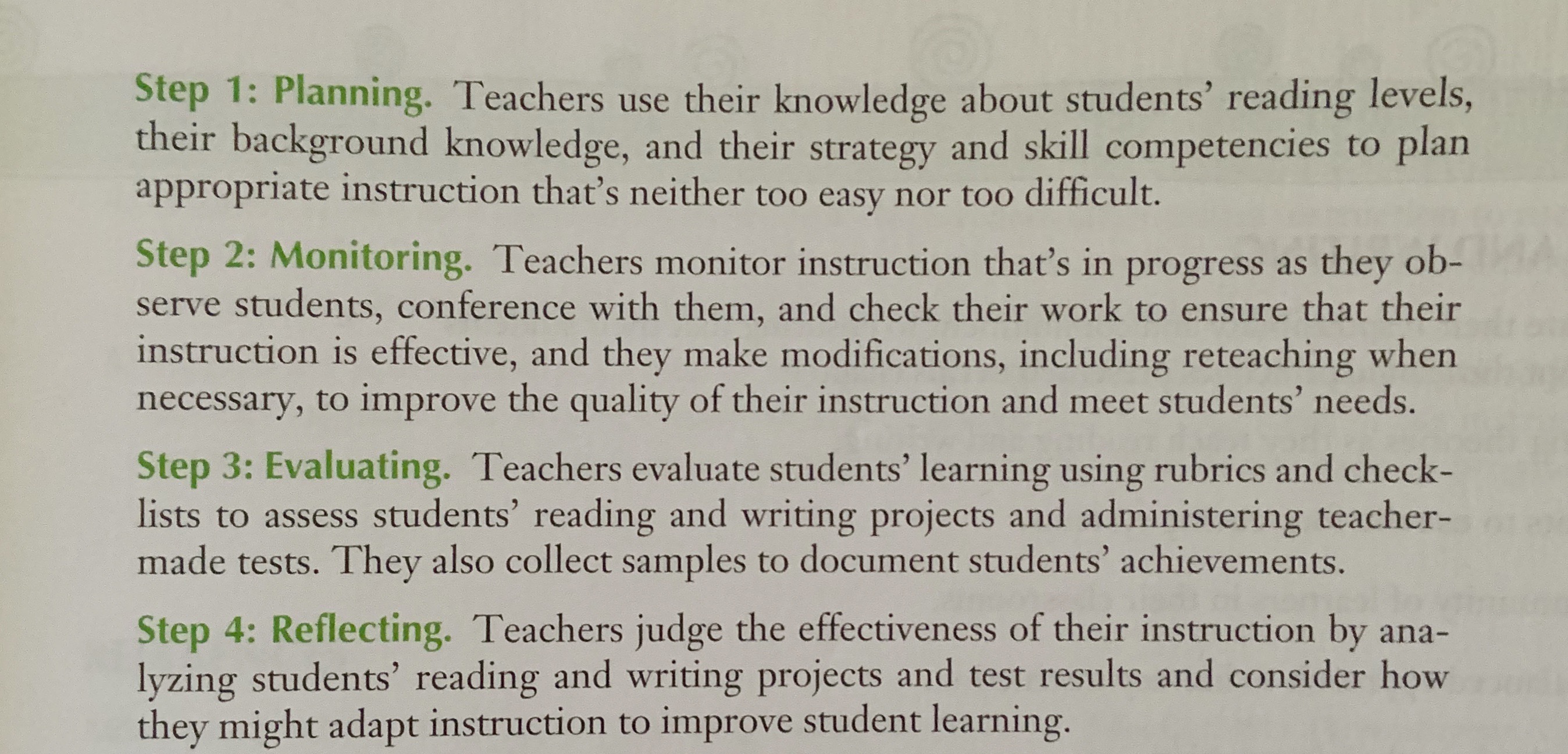
Linking Instruction with Assessment: Teachers link instruction with assessment using four steps. These steps are listed in the picture below.
Rubric: A set of guidelines and expectations for a specific project that assess the students work.
How will this look in my classroom?
All of these principals should be provident in the classroom. Rubrics and assessments are implemented everyday, whether they be observations or written evaluations. Differentiation is very important as well. This will be something I will try to execute everyday, with at least one lesson, because it is important to me that my students benefit from practice to the fullest extent possible.
Principal 1: Effective Teachers Understand How Students Learn
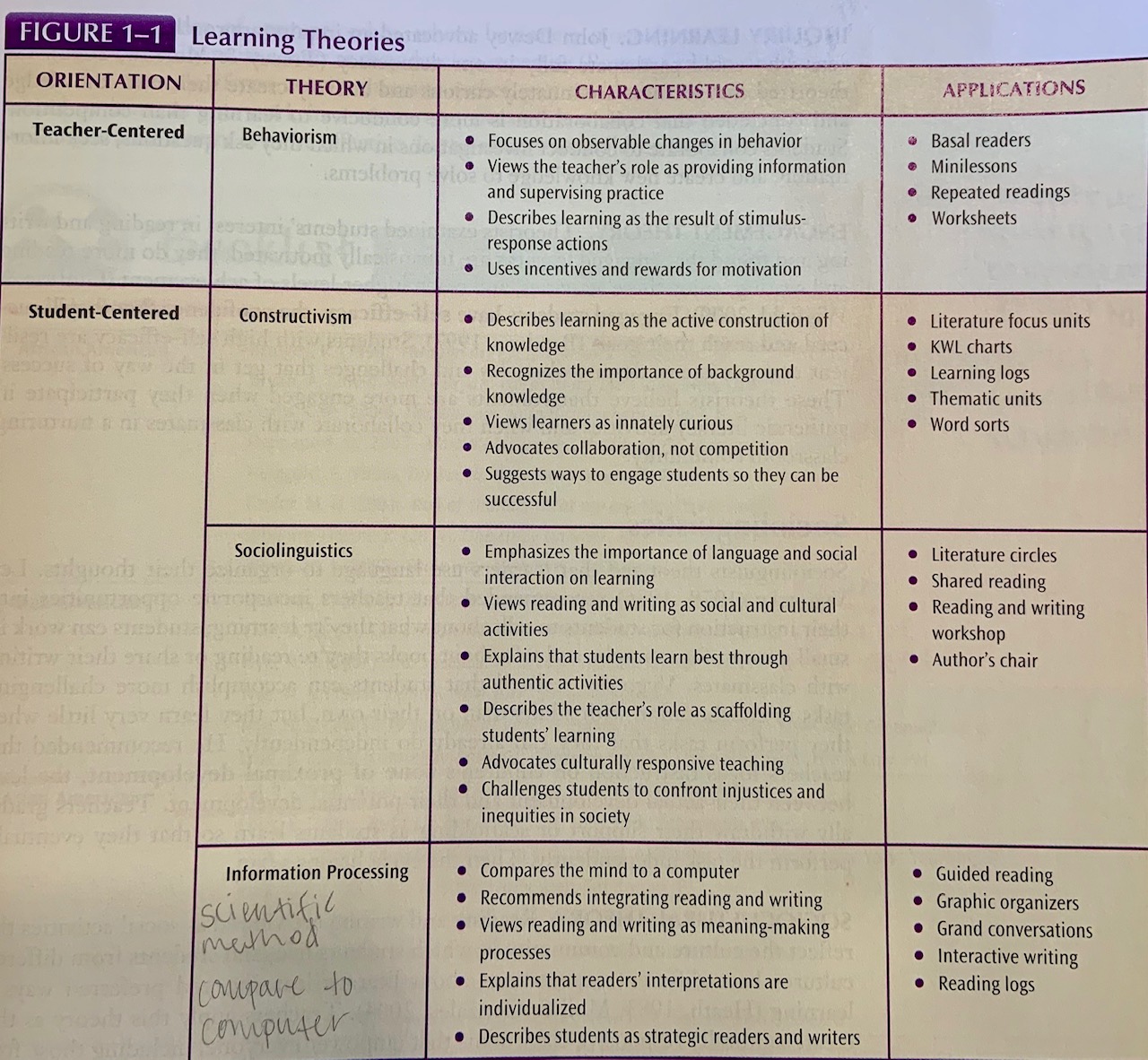
Understanding how students learn is the most important aspect of teaching. There are multiple student-centered theories that advocate for students learning and have become very influential.
Here is a diagram of Behaviorism, Constructivism, Sociolinguistics, Information Processing.
Vocabulary for Principal 1:
Schema Theory (Piaget) : This theory describes how students learn. This is the theory that learning is the modification of schemas as students actively interact with their environment. They learn through assimilation of familiar knowledge and accommodation of new knowledge.
Inquiry Learning (Dewey): The theory that learners are innately curious and actively create their own knowledge and concluded that collaboration is more conductive to learning than competition.
Engagement Theory: The theory that discovered engaged learners are intrinsically motivated; they do more reading and writing, enjoy these activities, and reach higher levels of achievement.
Principal 2: Effective Teachers Support Students’ Use of the Cueing Systems
This principal acknowledges that language is a complex system for creating meaning through socially shared conventions. The English language involves four cueing systems that are necessary for communication and are used by adults and children alike. These four systems are Phonological, Syntactic, Semantic, and Pragmatic.
Principal 3: Effective Teachers Create a Community of Learners
Classrooms are social settings. Together, students and their teacher create a sense of classroom community. The classroom community has a goal of inclusiveness and should feel safe and respectful so students are motivated to learn and are actively involved. Characteristics of a classroom community include safety, respect, high expectations, risk taking, collaboration, choice, responsibility, and family and community involvement.
Principal 4: Effective Teachers Adopt a Balanced Approach to Instruction
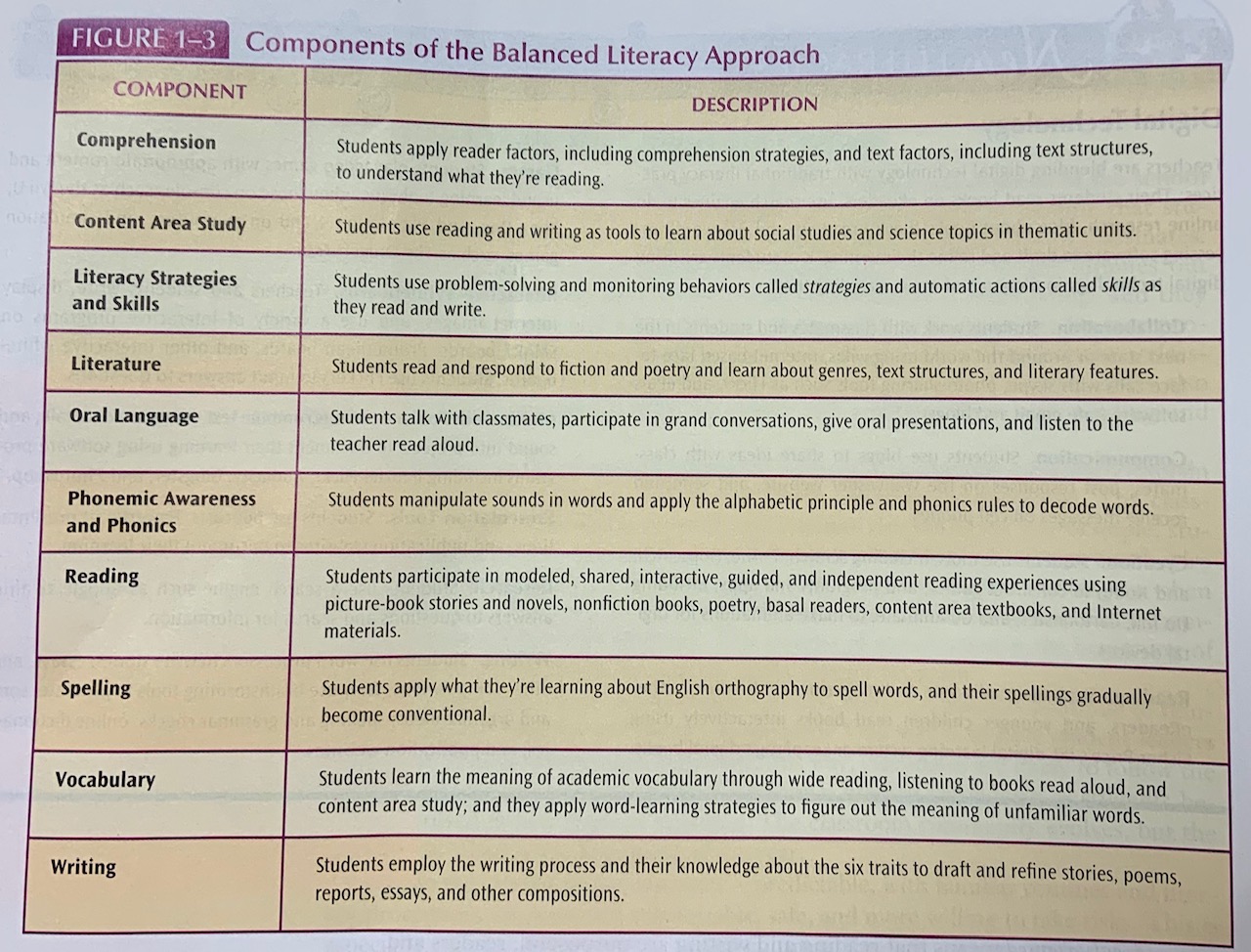
Reading is a complex process of understanding written text: readers interpret meaning in a way that’s appropriate to the type of text they’re reading and their purpose. Similarly, writing is a complex process of producing text: Writers create meaning in a way that’s appropriate to the type of text and their purpose. Reading and writing are dynamic, strategic, and goal-oriented. A balanced approach is based on a comprehensive view of literacy that combines explicit instruction, guided practice, collaborative learning, and independent reading and writing.
Common Core Standards
The Common Core State Standards for English Language Arts are a framework for improving teaching and learning, with clear and consistent academic benchmarks. The standards are research based and include rigorous content that requires students to use a higher level of thinking as they apply their knowledge, and they’re designed to be relevant to the real world.








 Payge Rivord